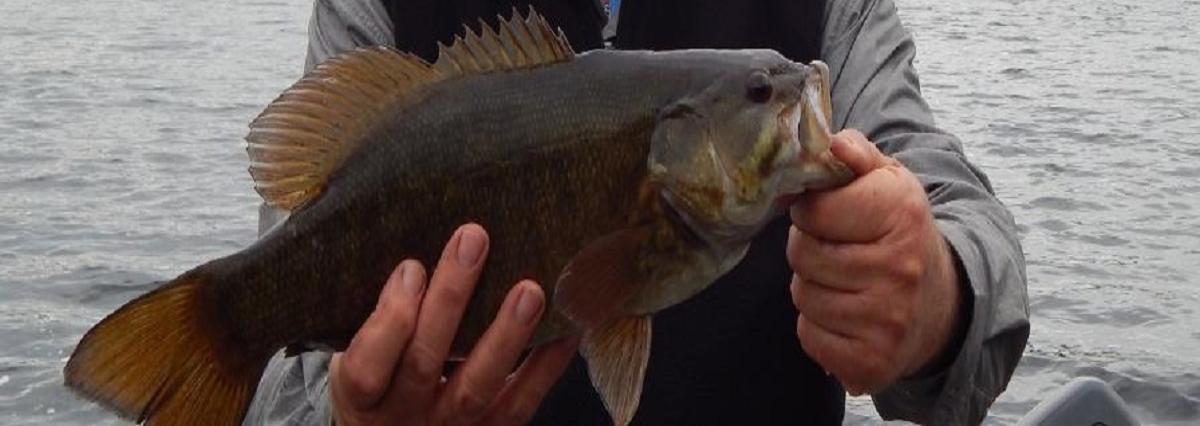
Smallmouth bass,(micropterus dolomieui) are members of the sunfish family. Their original native range was basically in the Mississippi River and Ohio River basins including the great lakes. They exist in the Tennessee River system as far south as Alabama. Originally, they were not found west of about the center of the United States. They have been stocked by various parties and means since the advent of the railroad and in most all cases, reproduce on their own. Now, they are found throughout the west, mid-western and eastern United States in all but three states.Males are generally smaller than the females, with grown males averaging about two pounds, and females about three to six pounds. Like most all fish, the smallmouth bass growth rate is determined by the amount of food present in their habitat, and the average water temperature. The average water temperature is a factor in determining the growing season of the smallmouth bass as well as its food.The color of the smallmouth bass can vary from lake to stream, stream to stream and lake to lake. They usually have a dark brown back. The sides of the fish is usually a bronze to brown color. They have the nickname “bronze backs”. Some anglers call them brownies. In some water you will find they are tinted green. Their stomachs are a light yellow to white color. The more you know about smallmouth bass and the food they rely on for their survival, the easier it is for you to catch them. The Smallmouth Bass is a predator. They feed mostly on minnows, baitfish, crustaceans, aquatic and terrestrial insects. Where crayfish are abundant, they usually comprise over two-thirds of smallmouth’s food.Although Smallmouth bass do school at times in certain types of water, they generally don’t cruise around looking for food. They are predators that like to hide and attack their prey. The wait for their prey to come to them and then attack the prey with a short, sudden burst of speed. When they are schooling, they are usually working together to push schools of baitfish up to the surface where they panic and become easy to catch prey.Two things to always look for when your fly fishing for smallmouth is food and cover. For example, if smallmouth bass exist in a lake or stream, rest assured that anywhere you find both rocks and crayfish, you will usually find smallmouth. You often have to determine the depth of water the fish are likely feeding in. This changes with the seasons, water clarity, and available light.Smallmouth bass found in rivers have to deal with current. Those found in lakes, generally don’t have to deal with much current and in some cases, practically none. As a general rule, river smallmouth have to consume more food than those found in lakes. They spend a lot more energy swimming in current and they have to replenish it by taking in more food than bass in still waters. River bass are almost always stronger than lake smallmouth. You will find that they have a different habitat from lake bass because they hold in areas that break the flow of current. They tend to relate closer to structure. They tend to hold in the slack water out of the current and ambush prey that has to deal with the current. Lake smallmouth bass also hide and attack their prey from cover, but current doesn’t play a role in it. There is an exception to that and it is that in man made lakes and reservoirs, discharges from dams can creates current in the lake and/or reservoir. In those cases, the smallmouth may position themselves in slack water, out of the current where they conserve energy and attack their prey. .In most lakes and streams, the easiest time to catch smallmouth on the fly is during the pre-spawn season. The fish are usually hungry and holding nearby the shallow water they will spawn in. Like most other fish, the spawning habits of smallmouth bass greatly depends on the temperature of the water. The males begin building beds when the water averages and remains for a day or two at about 55°F. The females bass will move to the beds shortly after it is finished. The actual spawning process will take place at water temperatures ranging from 60° to 65°F. The females usually deposit about 7000 eggs per pound of body weight. During this time, the male releases milt in the bed.
The most fun you can fly fishing for smallmouth bass is catching them when they are feeding on the surface. Nothing beats the fun and excitement of seeing a five, pound smallmouth come up from the bottom of a clear water stream and crash an imitation of a frog on the surface. It is often easy to attempt to set the hook before the fish actually has the fly in its mouth. The problem is, day in and day out in the typical smallmouth lake or stream, they are not feeding on the surface. Far more often than not, they are feeding beneath the surface and often near the bottom. Unless you just want to be a part time smallmouth angler, you better learn to fish to fish you can’t see as well as those that feed on top.Finding Smallmouth In Small Streams and Creeks:There are two types small streams and creeks. There are those large enough to float and those that are too small to float or restricted by regulations that do not allow boats. The techniques required to fish from a boat, small aluminum boat, pontoon boat, drift boat, kayak or other type vessel are quite different from those used wading. Many streams that hold smallmouth bass are just to small to float. You have to wade or fish from the banks to fish them. Fly fishing for smallmouth from the banks of a stream, usually limits what you can do.Wading Small Creeks and Streams:When wading, you have to be use stealthy approach. Keep in mind, in water clear enough for you to see the fish, the fish can also see you. You also have to wade quietly, not kicking or moving rocks and gravel around on the bottom of the stream. The bass can also hear you, or detect subtle vibrations in the water. Ripples you create when wading can also spook the bass.Any small stream that supports a good population of smallmouth bass will have some deeper holes or pools. A big smallmouth can be found in a small hole or pool, but those that are rather large, usually hold the larger size smallmouth. There should be some holes that are seven to twelve feet deep. This is necessary for the smallmouth during the hot summers and cold winters. During the spring and fall months, they are usually found much shallower. These are not hard rules, just general ones, so be aware this varies with water temperature, clarity and amount of light. In some cases it is possible to sight fish to smallmouth. This is not only effective at times, it is a very exciting way to fly fish for them.If you slip up to a pool and the water in front of you is fairly deep with good structure, but you fail to see any smallmouth, give it a little time. The fish can be hiding under something or just out of sight and you won’t be able to see them until they move. They can be spotted moving much easier than they can when they are not moving.Keep in mind that water with large rocks and boulders, or downed trees or deadfalls, create breaks in the current and provide hiding places for smallmouth bass. Areas of wide open water with little to no structure isn’t near as likely to hold very many fish. That written, in such cases, keep in mind that the only structure in such an area usually hold the only fish there, so don’t overlook that.A point to keep in mind, is during the warmer months of the year, smallmouth relate to the current and will never be far from it. You should position yourself downstream of boulders and eddies, and cast upstream, allowing the fly to drift drag free to you. As a general rule, smallmouth bass will be positioned behind the rocks and boulders on the downstream side. This isn’t always the case. They can be positioned in from of larger rocks and boulders in swift current because there is usually a relatively small dead area of almost still water.Fishing Small Creek and Streams From A Boat:Most small streams can be waded, but many don’t have the proper access points to wade from the banks. Others are too deep to wade and require some type of a boat or a float tube to fish. Float tubes are handy for those that don’t mind floating around half submerged in the water. Some streams move to fast to fish from a float tube. The water in the stream need to be very slow moving for their use, or otherwise, you can get into trouble fast.As far as the use of boats, often the one or two man type pontoon boats are most practical They are easier than most boats to tow, load, unload and launch. Other small streams fish well from small aluminum or fiberglass john and/or v-hull power boats. In many small streams, the best vessel is a canoe. It all depends on the particular water and the number of people you need to accommodate. Some streams prohibit the use of gasoline powered boats and require electric motors or paddles.In each situation, you have to take into consideration where you can access and exit the stream and how long it takes to get from one point to another. You have to know the stream well, or make absolutely certain there are no points you will encounter where to water too fast to handle, the water to low to navigate, or numerous other obstructions or dangerous situations you could possible encounter. Knowing these types of things is critically important in some cases, because you can become stranded in a stream after dark if your not careful. In other situations, you can reach your take out point much earlier than you want to, limiting your time to fish. Even worse, you can find yourself in a dangerous situation due to conditions and circumstances you were not aware of. Each stream much be carefully analyzed for any possible problems, not to mention the practical problems of catching fish.Finding Smallmouth In Lakes and Large Rivers:In clear lakes and large, clear rivers, smallmouth will travel great distances to take a fly during the middle of a sunny afternoon. If you can see the bottom of the stream or lake, chances are they can see your fly very well. In fact, they can see extremely well in clear water. The first and foremost way to fool them into taking your fly is to make sure your they look as realistic as possible. You have to try to take advantage of the fact they can see them well. You need to disguise your flies by matching them to the size, color and shape of the local forage. You can also use erratic movements to fool them, or in other words, keep the fly moving such they don’t get too good of a look at it.Sky conditions and water clarity affect how well the smallmouth see your fly. If your fishing the fly on or near the surface, wind can also affect how well they can see it. During the middle of the day in water less than ten feet deep, you can often fool the bass by imparting short twitches with the rod to make the fly dart from side to side. You can allow the fly to sink to different depths and begin the twitching action and rhythm. Often, the smallmouth will crush the fly and other times they tend to just follow it as if they are just curious about it. When this happens, it often works to just let the fly sink deeper and then resume the twitching rhythm. Often the key is finding the bait. You can sometimes see the bait but it not, a fishfinder, or sonar device can find it. When you spot globs of baitfish holding over structure, you will often find smallmouth feeding on them. In this case, it is usually best to mark the spot with a buoy, back off and return to drop a streamer in the area of the baitfish. This works well if the bait is staying in the same area, but often they are on the move, not holding in one area over structure. When they are on the move, smallmouth feeding on them will follow them. In this situation, you can’t just go back to where you caught them the day before and count on catching them. You usually have to relocate them on your fishfinder. If the smallmouth are not feeding on or near the surface,on the banks of the lake, and you don’t find the baitfish, your probably just waisting your time casting.You don’t have to use a fishfinder to catch smallmouth. Many anglers prefer to do it visually. The most obvious locations in lakes that are clear are rock shoals and drop off points. As mentioned in our other articles, smallmouth bass are predators that rely on hiding and attaching their prey, as well as chasing it down in open water. The fish usually relate to some type of object or structure such as a rock, log or weeds. They can also be found in schools. When they do congregate in schools, you will usually find the smallmouth bass are near the same size.Most lakes and large rivers require some type of boat to fish. Some are suited well for tube floats and others are too dangerous to fish from a float tube. Boats can range from a large variety and types ranging from motor boats of many different types; small boats with electric trolling motors; pontoon type vessels ranging from the one-man type to larger pontoon boats; drift boats; and kayaks,There are some lakes and large rivers that have areas of water with smallmouth bass that you can wade and fish. These places can be accessed in some cases from the bank and others require a boat to access the areas you intend to wade. It all depends on the particular water.The fly tackle, gear and equipment you need, greatly depends on which of these type of fishing methods you use. That will be covered under the gear, tackle and equipment section of this website.