First, although I’m sure most of you already know, I just want to make sure you understand what the term terrestrial insect refers too. Terrestrial insects are insects that are born and spend most of their life on land. They get into the water only by accident. Windy conditions and other natural conditions can cause these insects to sometimes loose their caution and end up becoming a meal for a trout.
It would be a rare occasion that trout ever became selective on any terrestrial insect. It would be possible during a flying ant fall, or possibly when a large amount of ants or beetles were washed into the water by heavy rains or high winds. This means that most all of the time, the trout are just looking for something to eat on the surface of the water. They do not recognize the various types or species of terrestrial insects that may come floating by. The strictly feed opportunistically on them. When there are few insects on the water trout are likely to take every insect that comes by.
If a large amount of any one insect became available over a period of time, then it would be likely that the trout would search only for that insect or feed selectively on it. When this happens, they begin to settle into a steady feeding rhythm and focus on individual insects. Facts are, it would be rare that enough terrestrial insects fell, blew or got washed into the water to cause selective feeding.
Imitations of Terrestrials: (Flies) This means that you can get by with, except for a few rare exceptions, fishing an imitation of any terrestrial insect you desire to imitate. As long as it is something of the size and shape of an insect, the fish will see your fly as something to eat. Their brain isn’t large enough for them to be able to identify it as something they saw last year at the particular time of the year. They they don’t need to be able to do so in order to survive. They may eat a beetle one minute and a grass hopper a few minutes later.
If the fly sinks, it will probably get more takes from trout than if it floats beautifully on the surface. Most ants, beetles and hoppers that fall into the water slowly sink.
These are some of the more plentiful and common terrestrial insects that get into the freestone streams of Yellowstone National Park.
Beetles: The most common terrestrial insect in the park is the beetle or Coleoptera. There are both aquatic and terrestrial forms of beetles but here we are concerned with the terrestrial form. Some species of beetles can fly and these are more likely to get into the water than the others that cannot fly. Overhanging limbs of trees, grass and shrubs provide the places for beetles to fall into the water.Flying Ant Grasshopper Beetle
Ants: Ants, the Formicidae family of insects, is one of the next most plentiful terrestrial insect found in the park. Fast rising water caused by heavy rains is responsible for ants and terrestrial beetles getting into the water more than anything else. Ants live in colonies and when they do get washed into the water, they usually do so in large quantities.
Some ants can fly and these flying ants can easily end up in the water. When they do, they are usually preyed on by trout in a feeding frenzy. These great swarms of arts perform their nuptial flights, the winged males or drones, die shortly after they swarm. If the flight of ants happens over a stream they fall in the water and usually just carpet the water. Don’t stand around waiting for this to happen, you may grow old waiting. But if you find flying ants falling in the water, the trout will usually go nuts. Be prepared for a flying ant fall. They usually occur during the late summer months.
Grasshoppers: Grasshopper exist on every stream in the park but they are not as plentiful in the forest as they are in the streams that flow through meadows and open areas where high grass exist.
Wherever you find banks with lots of grass there most likely are lots of grasshoppers. Grasshoppers become important starting in July but much more so in the latter part of the Summer and early autumn. They are apt to get into the water much more so on windy days.
Bees and Wasp: Bees live in colonies. These colonies are usually very large and contains thousands of insects. They sometimes fall into the water.
When the weather and water turns cold, the first question we usually get from anglers is when they can they use dry flies and when should they use sub-surface flies such as nymphs. The first warning I could give is that making this decision solely based on water temperature could be a big mistake. There are times when you may want to fish a nymph when the water temperature is 65 degrees F. and higher as well as times when it is 40 degrees F. There is no magic range for either the dry fly or one designed for subsurface presentations. A better question may have been “when does the water get too cold to catch trout on the dry fly”. With some exceptions I won’t get into, the general answer is around 45 degrees F. I have caught trout on dry flies at slightly lower temperatures ranges from 40 to 44 degrees F. This sometimes happens after an insect begins hatching following a day or two of 50 degrees or warmer water. If there is a lot of food on the surface the trout will usually eat it. By the way, when this happens, trout will usually eat the emerging pupae and nymphs much more readily.
During the spring months, trout will usually respond on the surface very well when the water reaches 50 degrees F. for a day or two. Dry fly fishing can even be excellent at this temperature provided hatches are occurring. Angie and I generally would start out fishing a nymph if the water temperature was below 50 degrees and not expected to rise to that temperature. Trout will eat the nymphs and pupae readily when the water is between the 45 to 50 degrees F range. You can catch them very well in this range provided other conditions are favorable. If you find the fish fairly concentrated, you can sometimes catch a lot of them when it is between 40 and 45 degrees F.
The next subject I will address pertains to where to find trout in cold water. More specifically on the bottom, mid-range, or surface. There’s no good answer to this question. The trout may be at either of those water levels depending on many factors. The water temperature is not one of them.
When trout are inactive, they tend to stay on or near the bottom. This also gives them some protection from overhead predators. You may also find them in very shallow water and of course, suspended between the bottom and surface. The water temperature is not the factor that controls this. Remember, the fish are perfectly comfortable anywhere in the stream, as far as the temperature is concerned. The main thing to look for is slow to still water. Trout want tend to hold for long periods of time in fast, very cold water because they will expend more energy than they can acquire food to replenish.
Now the problem with this is that you may be looking at a fast run, for example, with the surface water moving very fast, when down near the bottom, between and behind rocks, or within holes in the bottom, the water may be moving very slowly. In some situations, it may move very little. You cannot always go by what you see on the surface. For another example, water near the banks may be swift. However, there is usually some pockets along the bank where it is moving slowly. In eddies, water can even be practically still. Just keep in mind, moving water can be deceptive. Trout do not need depth from a temperature standpoint. It would be a rare situation in a trout stream for the water to get warmer deeper. Trout streams are generally not that deep. Even if they were, keep in mind, trout do not move to warmer water for comfort. They will feed more in warmer water but they won’t move strictly for temperature purposes.
Another cold-water question we often get, is very easy to answer – do you need to fish the sunny areas of the water in the winter months”? The answer to that (unless you can find some still water in the stream you are fishing, and there is usually little of that, is no. The sun has the effect of helping to warm the entire stream, even if it shines in only a few places. Since the water is moving, it makes little to no difference in the water temperature, even in the area the sun is shining on. It may help you keep warm, and it may even help you think you will do better but that is about it. It doesn’t mean the water is warmer there than it is downstream.
As ridiculous as it is, I sometimes believe that just the fact that anglers sometimes feel cold when they are fishing during very cold weather, allows their mind to play games on them. Solutions like “Fish the sunny spots line of thinking that the trout are cold and looking for warm water in the same sense we warm blooded creatures get cold can be very deceptive. “Fishing deep and on or near the bottom is a much better line of thinking. Line of thinking such as “you can’t catch trout in cold water” and other mistaken beliefs about fly fishing cold water, compare well to some of the best “Old Wives Tales”.
Dear Valued Customer, Save an average of twenty percent (20%) of the cost of flies by choosing a good, better or best option for one of our many fly selections for specific sections of the country, or by selecting a custom selection for any one or more particular streams. The selections come with or without fly boxes which, by the way, make excellent gifts for fly anglers. For help with choosing a selection, call us at 800 594 4726 or email us at sales@perfectflystore.com Click Here For Our Fly Selection Sales (Note: 2 pages of them)
09/26/22 Someone sent us an email asking which method of fishing catches the most trout – dry fly fishing on the surface or fishing flies below the surface of the water. The subject of email was fishing dry flies versus fishing flies below the surface. I first thought of responding by writing that it greatly depends on the percentage of anglers fishing dry flies versus flies fished below the surface of the water. I realized a different way of asking what amounts to the same thing could be, “what percentage of food trout eat is acquired on the surface of the water versus below it”.
As I was thinking of a response, it quickly flashed through my mind that the food wild trout rely on the survive could be aquatic insects, terrestrial insects, crustaceans, minnows, baitfish, fish eggs and other odds and ends. It also quickly occurred to me that the food varied depending on the type of water, species of trout, and many other factors. As those thoughts quickly flashed through my mind I realized that is also depends greatly on the intent of the angler, and by that I mean is the angler fishing for food for the table, fishing a European trout tournament, fishing for newly stocked trout, fishing for wild trout, or strictly for the sport of it. Probably everyone reading this knows that catching a trout on a dry fly on the surface is usually more fun and exciting than catching one on a nymph or streamer. No sooner than this thought crossed my mind, memory of a trip to Alaska several years ago, brought about pictures of very large rainbow trout jumping two to three feet in the air with my egg fly in its mouth. Not all trout caught below the surface fail to display a lot of acrobatic action. As I finally tried to get my mind focused on the question again, it occurred to me that if I was lost on a wilderness fly fishing trip about to starve to death, I wouldn’t dare tie on a dry fly to catch something to eat unless it was the only fly I had and even then, I would choose a live grass hopper or other creature over anything else.
As soon as I again become focused on the question, my thinking continued along the lines of probably less than one percent of the food trout eat is taken from the surface, versus 99 percent or more is taken from below the surface. Before I began to type that response on my computer keyboard, I realized many anglers who don’t tend to think about the things trout eat quite as deeply as I do, it may seem more logical that something more like ten percent of a trout’s food comes from the surface of the water would be a better answer. That is simply because it may seem to the person asking the question that I was insinuating that is is stupid for an angler to fish a dry fly. If I wasn’t thinking so seriously about the question, I may tend to agree with the ten percent of the food is taken from the surface answer. On the other hand, why should I respond with an answer that would likely be more pleasing to the person asking the question than I should respond with my true belief?
I’m well aware that I’m still not giving you proof or justifiable reason for my answer. I’m still trying to get your interest up about the subject, but now that I hopefully have accomplished that, here’s why I still think less than one percent is a good answer. First of all, consider the types of food trout eat. All crustaceans are all eaten below the surface. In some streams, there are only a relatively few and in some streams, such as spring creeks, crustaceans represent a huge part of the trout’s diet. The amount of minnows and baitfish depends greatly on the type of stream as well as the species of trout but in all cases, minnows and baitfish are eaten below the surface.
Next, lets consider a food source many of you will probably disagree with me about. Terrestrial insects are eaten by trout and many of them are taken on the surface, again depending on the type of terrestrial. Ants, beetles and inch worms generally sink when they land on the water. Hoppers usually float on the surface for a short time before sinking. Here again, the location and type of stream varies the amount for sure, but all things considered, terrestrials represent a very small percentage of the food eaten by trout.
Yes, I’m aware stomach sample taken during the Summer and early Fall in many locations show terrestrials are eaten by trout. I’m also know that Angie and I have set surface skim nets in trout streams nationwide for long periods during this time period (nights and days) only to discover almost nothing was captured. The results was far, far less than we anticipated. To get to the point another way, If you sit down and stare at the surface of a stream for hours, I would bet my last dollar you wouldn’t see the first terrestrial insect floating on the surface unless you were positioned on the bank of a hay field when a farmer was passing by cutting hay or you were fishing during high wind conditions. Also, consider that most terrestrial food is only available to trout for part of the year.
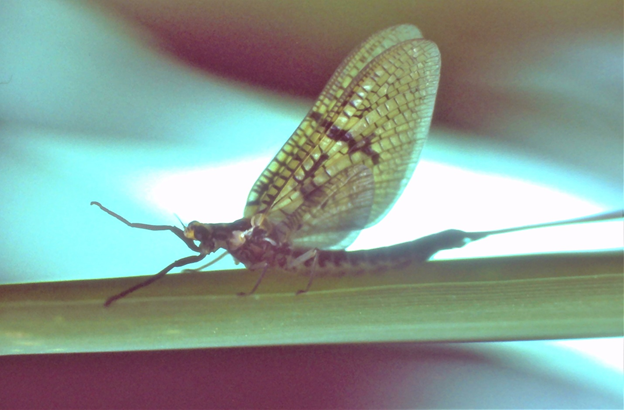
Now, let’s consider what trout mostly rely on for food and that is aquatic insects. Starting with mayflies, consider that a mayfly typically lives 364 days of the year beneath the surface of the water. It lives for only a few seconds as a dun on the surface. Some species of mayflies live two and a few even three years below the surface versus only seconds on the surface as a dun. Some mayflies, such as the Slate Drakes are never on the surface as a dun. They crawl out of the water to hatch. The female spinners of mayflies do mostly fall on the surface of the water when they deposit their eggs at the end of their life, but even they, they sink rather fast. The males mostly end up dying on land but they can fall in the streams.
Caddisflies are on the surface even less than mayflies because many of them crawl out of the water to hatch. There are not that many species that hatch on the surface. They too, spend a few seconds as an adult on the surface versus a year beneath the surface. The female egg layers do end up on the water, but only float for a few seconds and again, it’s mostly the females that land on the water. The males usually end up dying on land. Also, many species of caddisflies crawl below the surface or dive to the bottom to deposit their eggs.
Stoneflies are a different story altogether. They all crawl out of the water to hatch. They are eaten up to that point only as an nymph. The female adults do come back to the water to deposit their eggs and most of them probably end up on the surface for a few seconds or minutes, but they too, end up sinking.
Midges, the last major category of aquatic insects trout feed on, are similar to the caddisflies. The adults are on the surface only for seconds compared to weeks and months below the surface. Most of them are eaten below the surface as a larva or pupa during the hatch.
When you really think about it, in most cases, one percent is probably a high figure for the food trout eat from the surface. By the way, just to add another curve to the answer, how often do you think a large brown trout acquires its food on the surface? The answer is very, very little.
What does this have to do with your fishing? The answer is simple. The odds are far greater you will catch a trout below the surface as opposed to on the surface. Now, what is James Marsh really driving at? The short answer is trout see nymphs and larvae of aquatic insects, all of which are below the surface, far, far better than they see insects on the surface of the water. Even so, anglers pay far, far more attention to their dry flies than they do their subsurface flies. In fact, in general, they tend to think all nymphs look alike and they certainly don’t. By the way, that is why Perfect Fly nymphs that look like the real things. Most anglers completely disregard larvae. Many don’t even know the difference in the larvae and pupae. By the way, it is more difficult to catch a trout you can’t see, on a fly you can’t see, than it is on a fly you can see and a trout you can see when it takes the dry fly.
I’m not about to get into the argument of what is the best approach to fly fishing for trout – fishing with dry flies or subsurface flies such as nymphs, larvae and streamers. That is up to each and every individual angler. Personally, I enjoy catching trout. I enjoy catching a lot of trout and I enjoy catching small trout as well large trout. I enjoy the challenge including fishing the days it is almost impossible to catch one as well as the days it is like taking candy from a baby. I enjoy fishing for trout even when I don’t catch one.
Our hottest selling product: Flies including Stream and Species Fly Selections
Typical Perfect Fly Selection
We have our own line of products for fly fishing including our own fly patterns as well as our own line of fly rods, fly reels, fly lines, leaders and tippets, vest and packs, and many other fly fishing items. That allows us to sell directly from us to you the angler, without markup in price from distributors, representatives, or other middle men. Our number one selling products are our fly selections for different streams and locations throughout the nation and/or different species of fish. The selections can cover a specific time interval, season, or complete year. The selections can match any dollar budget amount you desire or our standard good, better, or best selections. There are specific fly selections for certain species of fish such as Pacific or Great Lake Steelhead, just for an example.
In the northern parts of the U.S., brown trout will soon be starting their annual spawning activity. Of course, this is due to the cooler climate which results in water temperatures that are much lower at this time of year than those in the middle and southern parts of the nation. Yes, it is still early for the great majority of spawning to take place. The water temperature is still on the high side, nation wide for spawning. Also, many streams are still to low from what would be considered ideal from the brown trout spawn. From talking to anglers just about every day throughout the country for the past several years, it is obvious to me that many are not aware of what actually takes place during the spawning cycle. I think all anglers should be at least basically aware of what takes place. The brown trout are much like salmon in that they will travel upstream long distances to spawn. It is thought that many of these trout will actually return to the same location that they used in previous years to spawn. I understand some testing showed this to be a fact. They have to come out from their normal hiding places to do that and they can often be spotted in a stream during this time. To begin with, the trout need to be in excellent shape to begin the spawning process. It takes a lot of energy to make the moves they make. They need to be in prime condition and many may not be due to recent periods of drought. Ideally, there are several factors that the trout take into account when spawning or maybe I should say, that Mother Nature takes into consideration. One is the water temperature which I just mentioned, but others are water depth, current, light penetration, type of bottom and probably many other things that we are not off hand aware of. The water depth can vary for sure. After the trout have made their trips upstream, all these things affect the exact time and place the spawning process takes place. The female brown trout builds her redd using her tail to move the gravel around. Some call this a nest and bass fisherman call it a bed. She selects small gravel areas. They prefer gravel about the size of a single peanut but will take whatever they can get as far as the size of the gravel is concerned. She cuts a trench or area of bottom where she will deposit her eggs. At just the right time, she will deposit her eggs in the gravel. Prior to her covering them up and usually during the same time period, the male will deposit his milt or sperm on the eggs. She will then proceed to cover the eggs up with gravel. This process helps by improving the flow of water through the eggs by cleaning the sand and dirt from the gravel. It is my understanding that this is critical in whether or not the eggs survive. This may not all occur at once. She may move to another area of the redd and repeat this procedure along with the
male. It is my understanding they deposit as little as a thousand eggs (not over two or three thousand), much more than I would have thought. Obviously, many of these eggs never make it. This entire procedure from the beginning to its end puts the fish in a stressful situation. It takes a lot of energy. It is also my understanding, that the adult fish experience their largest morality rate during the spawning process. The eggs themselves can be destroyed by insects, fungus, and silt, to name a few things.
Anglers are another culprit that can destroy the eggs as well as the entire process of spawning. During the spawning process the fish are very aggressive and territorial. This is especially true of the male. During the time the fish are building their nest, depositing their eggs and sperm, etc., anglers catching either the male of the female, can destroy many brown trout. Even if the angler doesn’t catch the fish he or she poses a threat to the process by adding additional stress to the fish. If he or she steps in the nest either before or after the eggs have been deposited, many or even most all of the eggs can be destroyed. If the female doesn’t deposit all of her eggs, she can die. These spawning fish are large fish. Although it is not exactly the same case with brown trout, they remind me of redfish that must be older to successfully spawn. The angler can easily catch these spawning fish, smile and show others how great they are at catching big fish and many will never know what actually occurred. It doesn’t matter if they catch the female or the male, a lot of brown trout can be destroyed from the results. Both are critically important to the spawning process. In many streams in the country, the fishing season is closed during the brown trout spawn. In other sections of the country, certain sections of the river or stream that are know spawning areas are off limits to anglers during the brown trout spawn. The fishery managers will tell you that fishing for spawning trout has little overall effect on depleting the population of brown trout and I am sure that is correct. It is not against the rules and regulations to catch the spawning brown trout in many streams throughout the nation. That is a decision you must make. If you can take pride in catching an over aggressive, easily caught trout (male or female) that will stay in one area of the stream trying its best to play its part in reproducing its like, then go ahead and catch them. Personally, I don’t want any part of it but neither am I going to be critical of those that disagree and choose to do so.
Our hottest selling product: Flies including Stream and Species Fly Selections
Typical Perfect Fly Selection
We have our own line of products for fly fishing including our own fly patterns as well as our own line of fly rods, fly reels, fly lines, leaders and tippets, vest and packs, and many other fly fishing items. That allows us to sell directly from us to you the angler, without markup in price from distributors, representatives, or other middle men. Our number one selling products are our fly selections for different streams and locations throughout the nation and/or different species of fish. The selections can cover a specific time interval, season, or complete year. The selections can match any dollar budget amount you desire or our standard good, better, or best selections. There are specific fly selections for certain species of fish such as Pacific or Great Lake Steelhead, just for an example.
A family fly fishing trip to the beautiful Colorado Rocky Mountains
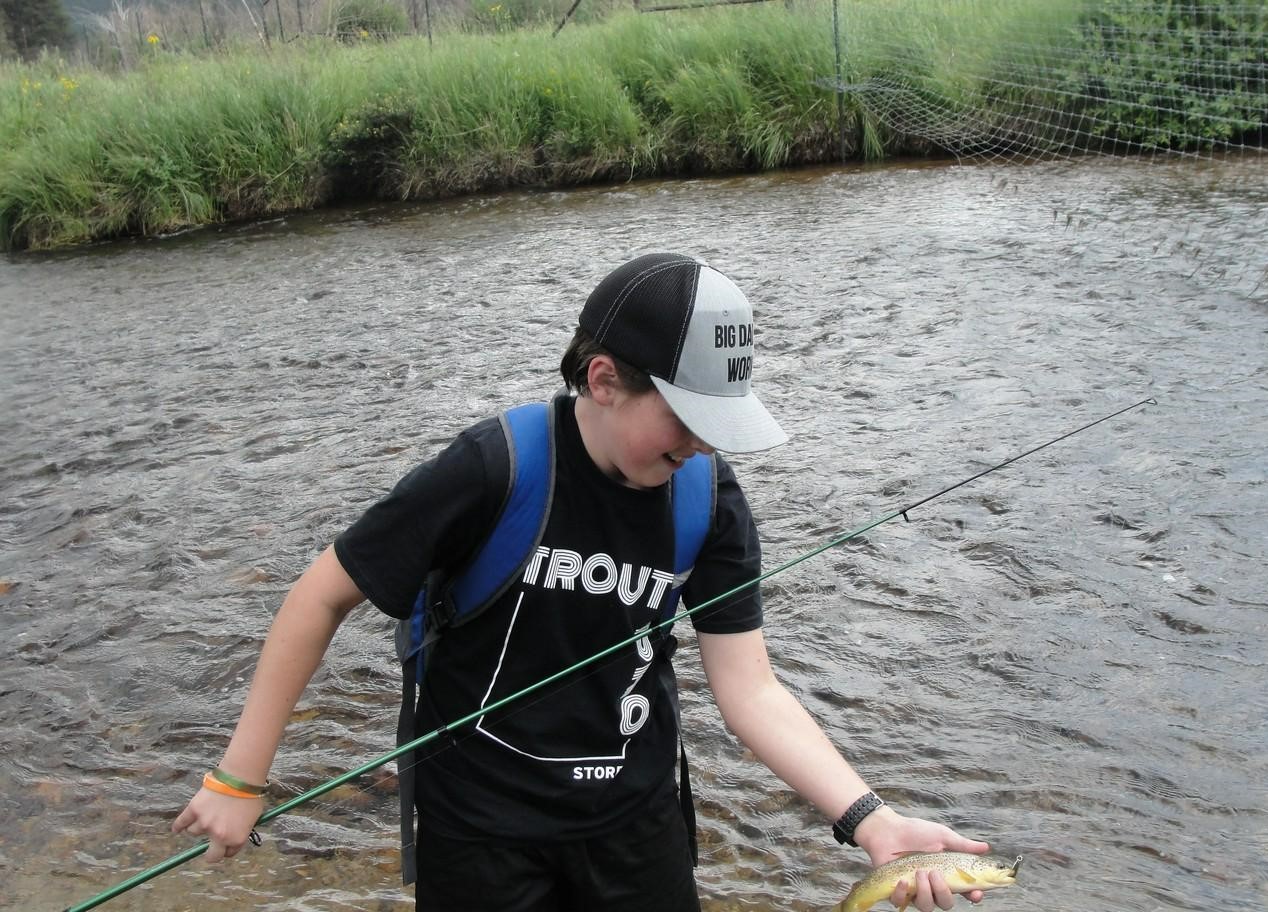
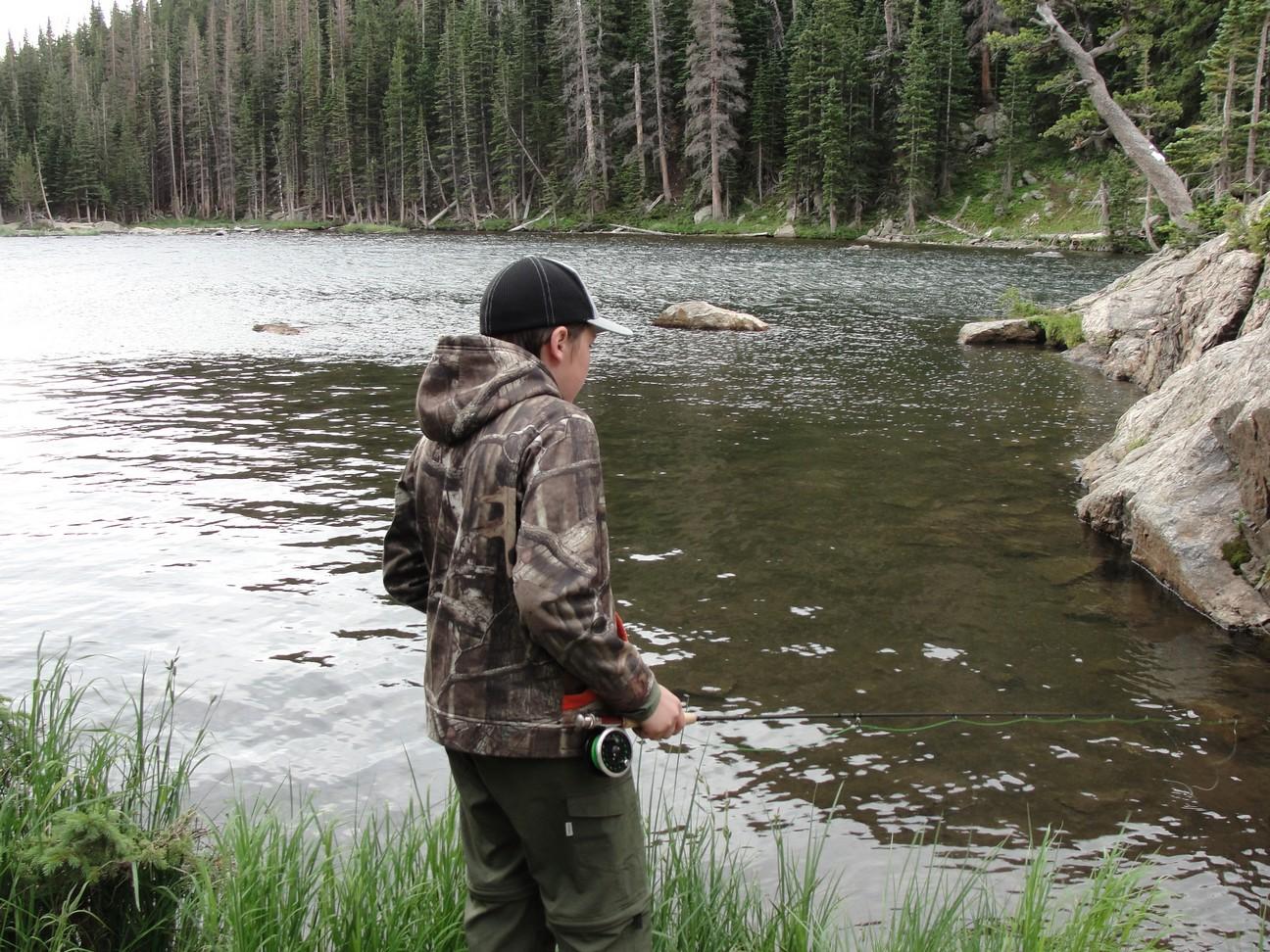
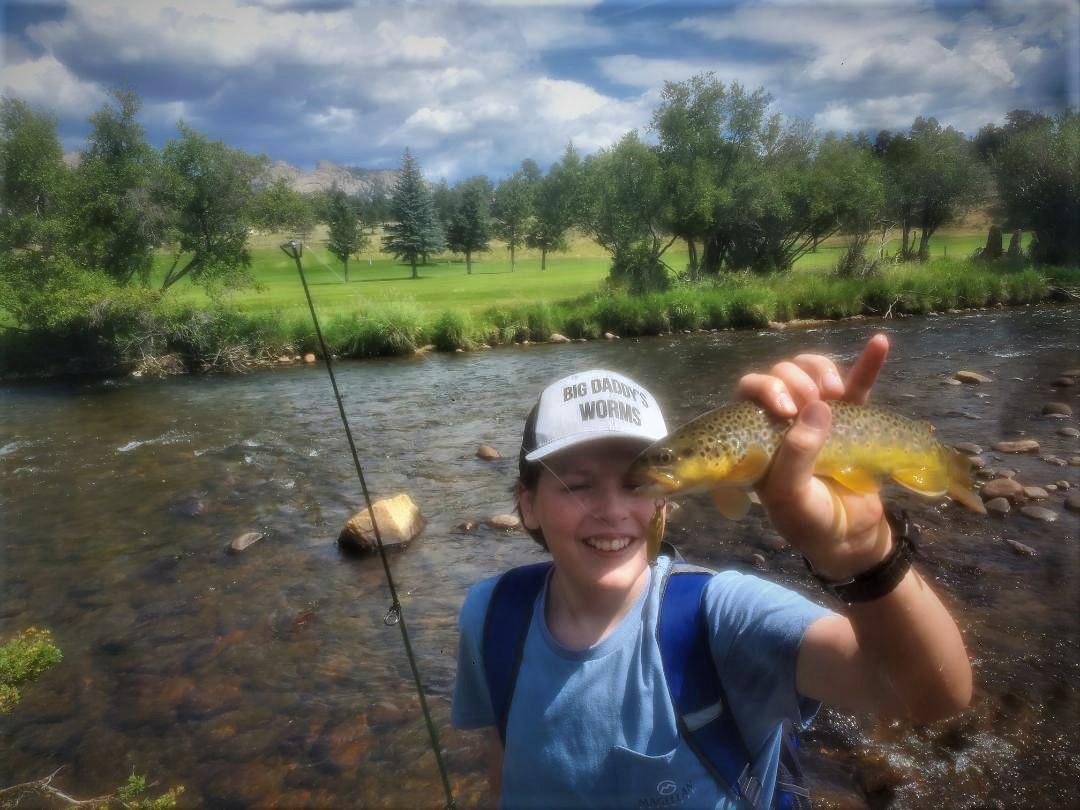
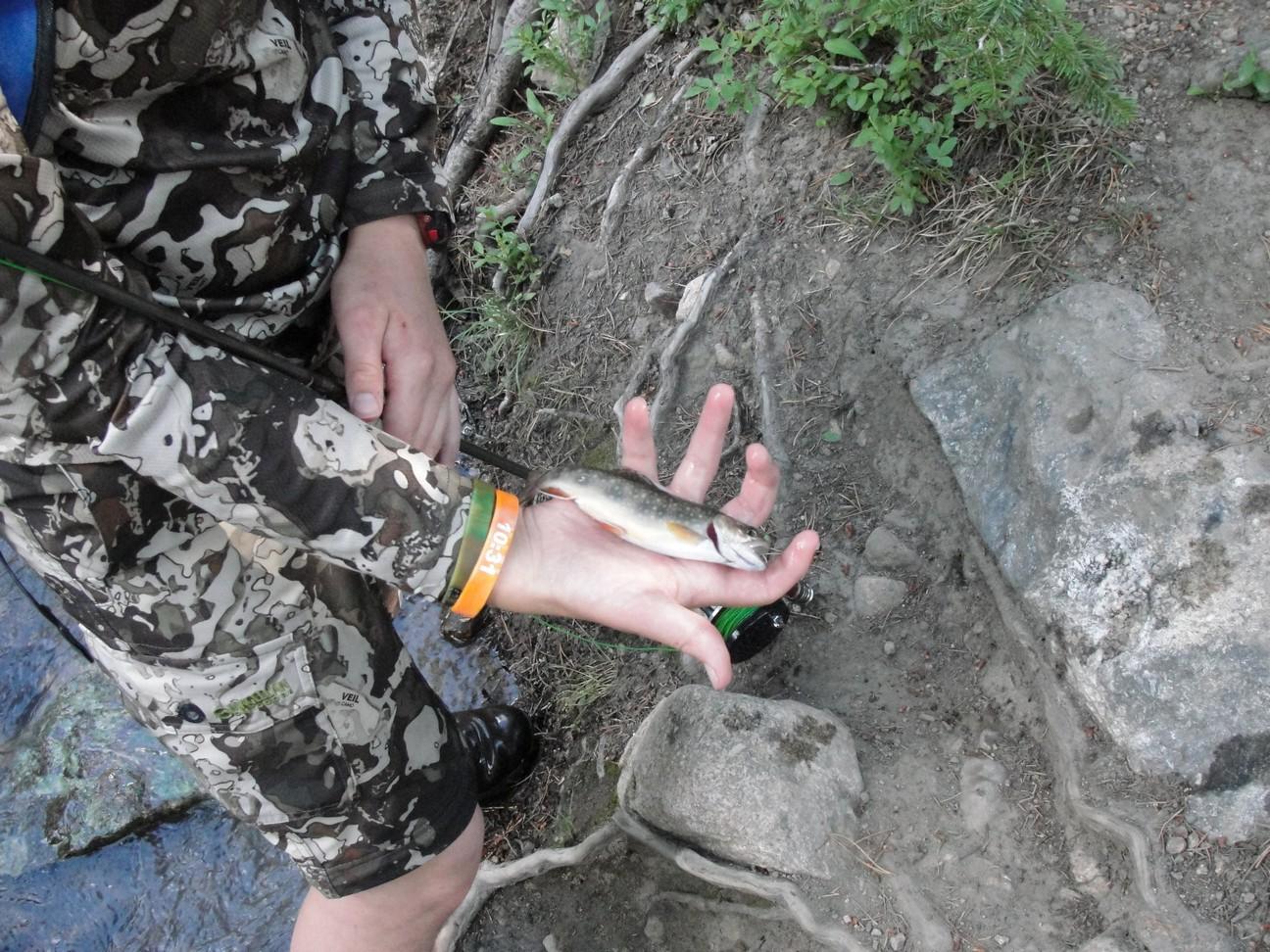
Drew Maslar with a nice Big Thompson River Colorado TroutDrew fishing the small lakes in the Rocky Mountains of Colorado
Several years ago I had a call from a North Carolina man named Jerry Maslar who said he wanted to know if Angie and I would sell Perfect Fly Company. The answer was no, but after meeting him in person, I encouraged him to form his own fly fishing company. After a brief time of operating as Trout University, Jerry decided that in addition to educating anglers fishing for trout that he would sell the complete line of Perfect Fly products and fly patterns, which he was helping Angie and I promote, Knowing the tremendous success of Johnny Morris, from the time he and I fished many of national BASS tournaments at the same time during the late 1970s, prior to his forming Bass Pro Shops, my advise to Jerry was to name his company Trout Pro Shop or Store. That he did – Trout Pro Store – www.troutprostore.com. Jerry and I soon became close friends. His Trout Pro Store started out selling and still sells all of our Perfect Fly trout fishing products and complete line of trout flies. Jerry was a huge help to Angie and I. Not only did he provide excellent advise for our company, he even built the wooden cabinets that we still store our flies in. He visited us often and even worked some local Fly Fishing show events with me.
Through the past approximate fourteen years of being very good personal and business friends, I had the privilege of meeting his son Steve, who now runs the company. I have yet to meet Drew, Steve’s son, now twelve years old who was just a baby in our early years of friendship. It is quite obvious, he is following his father and grandfather’s fishing footsteps. Steve and his wife Carleen, took Drew and his two sisters Emma and Caroline on a family vacation to Rocky Mountain National Park. The girls took some pictures and video of the trout fishing and went hiking with Steve and Drew. They managed to catch several trout in beautiful places in a rather short time.
Drew with another oneGo Drew
This is about how a father and mother can influence their sons and daughters in a fun and pleasurable way in the great outdoors. This should be dedicated to the many father and mothers who do just that. The Maslar’s recent trip to the Rocky Mountains reminds me of many trips my father and grandfather spent time taking me fishing in my early years. I can remember many trips in detail from as far back as seventy years ago. I have two beautiful daughters rather than a son. Both of them fished with me often from their early childhood. They are now both in their middle ages and they still fish together in lakes nearby their homes in central Alabama rather often. I do have a grandson that I have been able to take both fresh and saltwater fishing.
From 1980 to 1985, I produced and was the host of a thirty minute, weekly television show first called the “Gulf Coast Angler”, and later when we expanded nationwide “Fishing with James Marsh”. It was the first ever national syndicated TV show on saltwater fishing. At the conclusion of the program, I made the following statement over background music from Don William’s song “Lord I hope this day is Good”. It went like this – “Do yourself a favor friends and take a child fishing. You will gain a friend for a lifetime but teach them to protect our natural resources. You know if God didn’t intend for us to spend more time fishing than working, he wouldn’t have put more water here than land. Keep what you need to eat but release the rest for me to catch. Until next week, God Bless”. Of course, it was a little silly but my intent was to push “catch and release” which in those years was in its early stages.
Creating a great outdoor relationship isn’t complicated. It’s very simple. If you are lucky enough to have one, just take your son or daughter fishing. If not, take any youngster you know fishing. You will gain a friend for a lifetime. It almost always creates an unforgettable experience for both of you.
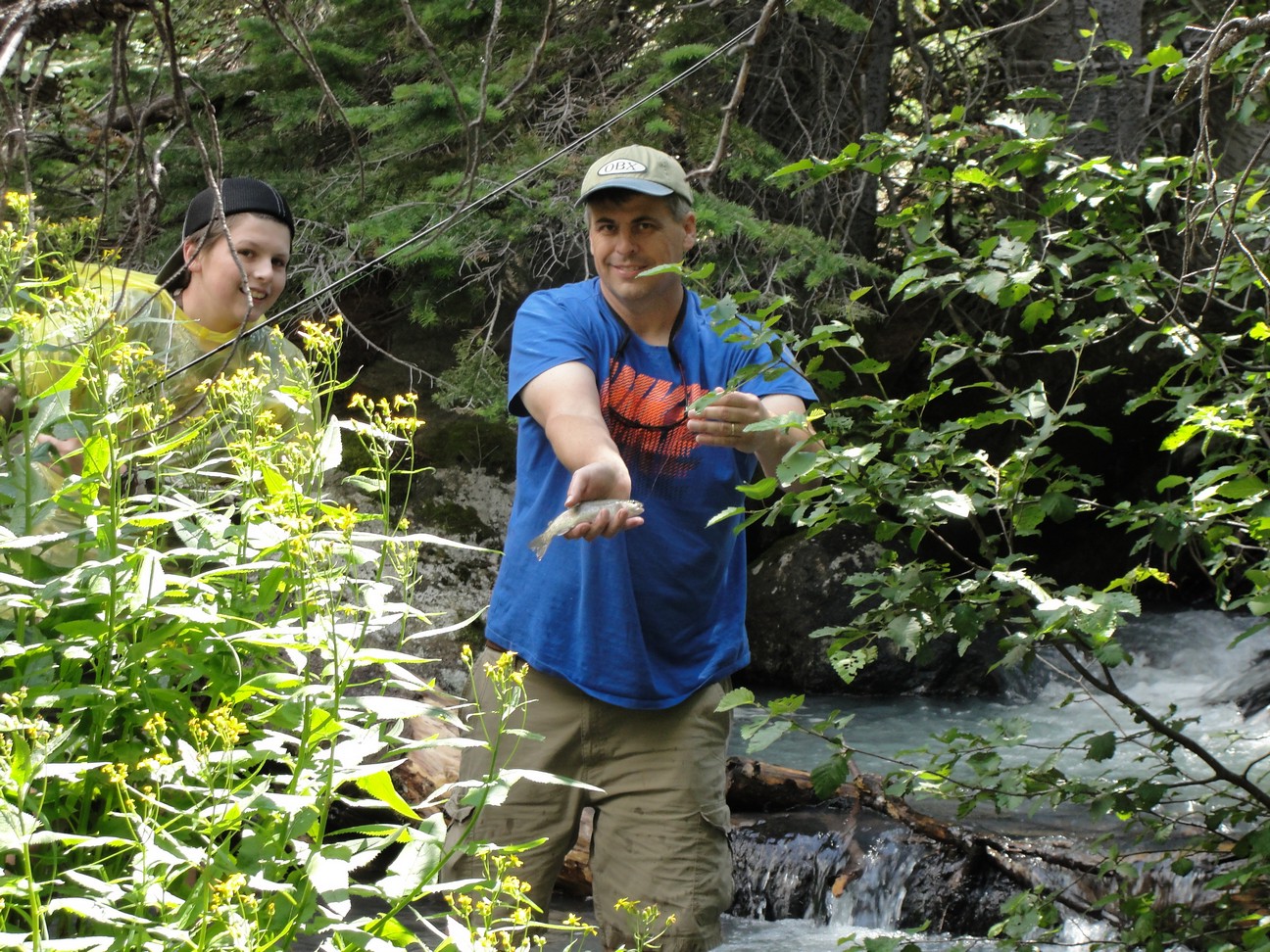
Sorry, we forgot to show Steve, the “Dad’s” trout.
Steve Maslar
Our hottest selling product: Flies and Stream and Species Fly Selections
Typical Perfect Fly Selection
We have our own line of products for fly fishing including our own fly patterns as well as our own line of fly rods, fly reels, fly lines, leaders and tippets, vest and packs, and many other fly fishing items. That allows us to sell directly from us to you, the angler without markup in price from distributors, representatives, or other middle men. Our number one selling products are our fly selections for different streams and locations throughout the nation and/or different species of fish. The selections can cover a specific time interval, season, or complete year. The selections can match any dollar budget amount you desire or our standard good, better, or best selections. There are specific fly selections for certain species of fish such as Great Lake Steelhead, for example.
If you plan on fly fishing for trout, you better get used to the term “(the name of the stream) flies”. For example, Madison River trout flies. Although the name infers there’s something unique about the flies you need to fish that stream, there isn’t. The purpose of the fly is to fool the trout into taking it for one of the insects or other items of food the trout are eating at the time. If the fly does a good job of that, there won’t be anything unique to the stream you are fishing about it. The insects and other trout foods that exist in trout streams are the same insects and other items of food that are found in the streams of most other states within that geographical area. Just to make a point, consider that in fact, several species of aquatic and terrestrial insects found in Yellowstone National park in the West exist Great Smoky Mountains National Park in the East. The same thing is true of most of the baitfish, minnows, sculpin, and crustaceans that are in trout streams.
Since the various foods the trout eat aren’t unique to the streams of the particular stream you intend to fish, neither are the flies you need to catch the trout. The only thing that should be unique about the flies is they should imitate the specific insects and other foods the trout eat in that particular stream. The more your fly resembles the appearance and behavior of the most plentiful and available food the trout are eating at the time you are fishing, the easier it will be for you to fool the trout into taking your fly for the real thing.
Please don’t refer to this solely as “matching the hatch”. It involves much more than that. It’s also matching the 99.9 percent of the aquatic life in the streams that has not yet hatched. It should also mean “matching the egg layers insects”. It should even include “matching the dead”, or the mayfly spinners and other aquatic and terrestrial insects that fall into the streams and die. Don’t forget the other trout foods. Call that “matching the sculpin and minnows” if you like. Instead of improperly calling everything “matching the hatch“, just call it “matching the naturals“. Even better, just think of it as matching the food the trout will be eating at the time and place you are fishing with a flies that closely resemble those particular food‘s appearance and behavior.
To make this simple, first determine or find out what the trout are most likely feeding on at the time and place you plan on fishing. This information is available from Perfect Fly by phone at 800 594 4726 or email at sales@perfectflystore.com. and match that food with flies that look as much like the real things (Perfect flies) which are available at the same place.
Our hottest selling product: Flies and Stream and Species Fly Selections
Typical Perfect Fly Selection
We have our own line of products for fly fishing including our own fly patterns as well as our own line of fly rods, fly reels, fly lines, leaders and tippets, vest and packs, and many other fly fishing items. That allows us to sell directly from us to you, the angler without markup in price from distributors, representatives, or other middle men. Our number one selling products are our fly selections for different streams and locations throughout the nation and/or different species of fish. The selections can cover a specific time interval, season, or complete year. The selections can match any dollar budget amount you desire or our standard good, better, or best selections. There are specific fly selections for certain species of fish such as Great Lake Steelhead, for example.
During the late Summer and early Fall, many trout streams become very low due to the lack of rainfall. In these cases, if the air temperatures become very hot, trout streams can get low of oxygen in bad condition and fishing can become very tough and stressful on the trout when you are successful in hooking one.
If the water temperature is not too warm and catching trout isn’t going to place too much stress on the trout, you can be sneaky and make good presentations you can still catch plenty of fish. By too warm, I mean water temperatures that are over seventy degrees F. Everyone is probably aware that you should stay low, dress correctly and stay hidden from the trout. Those things are basic for fishing small streams, especially under low water conditions. What prompted this writing is a factor that I think many anglers overlook.
If you move extremely slow, the trout are far less likely to notice you. Trout can see almost all the way around themselves. There’s only a small area directly behind them, called the blind spot, that is not within their peripheral vision. I have found that as long as you move extremely slow, they won’t notice you in their peripheral vision area of coverage nearly as quickly as they will when you move at a normal pace. By that I mean not only move you body very slowly, but refrain from the making the movements necessary to cast. Low, side arm and low roll cast made while wading help avoid the trout seeing your or your rod’s movement.
By using this the low side arm cast procedure, you can often approach trout in extremely clear water. I have fished spring creeks in Pennsylvania and Montana using this procedure without spooking them, but doing so is not easy. Moving at a slow, slow pace is not easy to do. It seems you will never get into a position to cast and then when you do, you must do so with the flip of a wrist, side-armed and very low. That means you can’t cast very far and that means you have to get very close to them. I have caught brown trout as close as fifteen feet from me in shallow, extremely clear water, looking at the fish when I was standing my full height which is six feet, two inches.
Most of the time I make the mistake of moving too fast. I am not very patient any way and fishing at the pace of a snail isn’t easy for me to do. What I am describing is not a cure all for catching fish in low, clear water by any means. Casting to a trout may take a few minutes of ultra slow-motion movement before you attempt the first and only cast you will get. If I am on the bank, I usually stoop down to my knees in slow motion when I do get close to the fish and then cast side-armed with as little body movement as possible.
Please note that I’m not contending that this is the way to fish normal, low water conditions. I don’t think that extent of extreme caution is necessary in most cases. I do wish to stress the point that trout do not notice your presence by identifying or determining that you are some type of creature from out of space that is going to harm them. Without turning and placing you in their very narrow binocular area of vision, they cannot see you well enough to determine anything other than something is in their area that doesn’t belong there.
If you were in the woods observing the forest and one of the trees suddenly moved a couple of feet, you would spook. If a tree started moving towards you at a rather fast pace, you would really freak out. When a portion of the trout’s surroundings suddenly moves, it will freak out. Slow your movements way down and you will catch more trout under low water conditions.
Another little used method is to drift the fly downstream to fish. It helps to spot one rising so you can target it as opposed to blind casting but both approaches can be successful. The key is to not let your fly line cross over a fish’s position. Only the leader or better, only the tippet should do that or otherwise, you will be done with that trout. Just make a little short cast and feed the line downstream to likely position that may hold trout. Mend the line to place the fly at least a couple of feet or more either left or right of the line of the drift of the fly line. This method is commonly used on the Henry’s Fork of the Snake River in Idaho where the water is smoother and slick such as it is in the old railroad ranch section.
Trout still eat in low, warmer, clear water. In fact, they need more food under these circumstances than they normally do. The single most important thing to keep in mind is to always fish water that is highly oxygenated, not slow moving still water regardless of the depth. Plunge pools, riffles and runs will hold feeding trout under low, warm water conditions.
Our hottest selling product: Flies and Stream and Species Fly Selections
Typical Perfect Fly Selection
We have our own line of products for fly fishing including our own fly patterns as well as our own line of fly rods, fly reels, fly lines, leaders and tippets, vest and packs, and many other fly fishing items. That allows us to sell directly from us to you, the angler without markup in price from distributors, representatives, or other middle men. Our number one selling products are our fly selections for different streams and locations throughout the nation and/or different species of fish. The selections can cover a specific time interval, season, or complete year. The selections can match any dollar budget amount you desire or our standard good, better, or best selections. There are specific fly selections for certain species of fish such as Great Lake Steelhead, for example.
Some anglers tend to want to avoid fishing during the so called “dog days” of summer. Dog Days are usually considered to be the hottest days of the year ranging from about the second week of July to the middle of August. In ancient times, people associated the heat during this period with the concurrent rising of Sirius, nicknamed “the dog star. When it comes to fly fishing for trout, much of this line of thought has to do with the particular part of the country one is considering for the next fly fishing adventure. For example, if one is considering a stream located in Montana, this period of time may be considered to be one of the best times for fly fishing for trout. If one is thinking of Southern California or North Carolina, August is usually the prime time of the so called dog days and many anglers tend to think it is a bad time to catch trout on the fly. If the main consideration is choosing a comfortable time to fish, fishing during the dog days isn’t considered a good choice. If the main consideration is catching trout, it shouldn’t be a factor at all. Fishing during the dog days of summer, shouldn’t approached any different than fishing during any other time of the year. It does require some different strategies. It usually does require imitating some different types of food the trout will be focusing on, but it shouldn’t be approached with any negative attitude or thoughts about ones odds of success.
First of all, I think it is a big mistake to start thinking in terms of only fishing during the early morning and/or very late afternoons when the weather may be a little cooler. That may be a proper consideration if one is fishing water that is reaching a temperature over seventy degrees during the hottest part of the day; however, the best solution to that would be to choose another location with lower water temperatures. In some rivers, that simply means choosing a location on the stream at a higher elevation. In many streams, that means choosing a completely different small stream or river.
A huge factor to consider is the type of water you fish within the stream. It isn’t the direct affect of the temperature of the water that affects your odds of success or strategies you should use. Warmer water holds less oxygen and that should be a main consideration. You should fish the sections of the stream that contains the most oxygen such as runs, plunges and riffles. You should avoid fishing still water within the stream and other areas with the slowest moving water such as found in most large pools. The water depth makes little to no difference. The most oxygenated water in the stream may be only inches deep.
Another very important consideration as always is you should be imitating the most plentiful and available food the trout have to eat at the particular time you are fishing. Yes, many anglers turn their attention to terrestrial insects and they are important during the dog days but as I recently wrote a short article about, they shouldn’t be considered more important the the aquatic insects that may be available unless it is during times that mother nature is putting a lot of the land based terrestrial insects into the water with strong wind or water flowing into the stream from heavy rainfall.
Aquatic insects tend to be a little smaller than they are at other times during the spring, summer and fall months. The little White Wing Curse, or Tricos, are present in most streams and very important. Little Blue-winged olives can be important in many trout streams. Little Sister caddis, is one of the smaller size caddisflies that can be important during the dog days. Little Yellow stoneflies usually continue to be important. I don’t mean to imply that there are not any large aquatic insects that may also be hatching although there are usually less of them than they are at other times. I’m only pointing out some small ones that are usually very important. Crustaceans and baitfish usually don’t vary in size from other times of the summer months.
A bottom line consideration here is you should know how to properly present the small aquatic insects like the tiny BWOs and Tricos. You should also know how to change the fly your are using to match the stage of life of the little mayflies, caddisflies and stoneflies for the time of day you are fishing. The final statement I will make for this article is I pay no attention to those who want to distinguish the so called dog days of summer as being a poor time to fly fish for trout. It isn’t.
Our hottest selling product: Flies and Stream and Species Fly Selections
Typical Perfect Fly Selection
We have our own line of products for fly fishing including our own fly patterns as well as our own line of fly rods, fly reels, fly lines, leaders and tippets, vest and packs, and many other fly fishing items. That allows us to sell directly from us to you, the angler without markup in price from distributors, representatives, or other middle men. Our number one selling products are our fly selections for different streams and locations throughout the nation and/or different species of fish. The selections can cover a specific time interval, season, or complete year. The selections can match any dollar budget amount you desire or our standard good, better, or best selections. There are specific fly selections for certain species of fish such as Great Lake Steelhead, for example.
Angie Marsh dressed right for the hot weather of summer
By James Marsh
We want to republish this older post on fly fishing during the summer months and warmer water.
The hot weather of summertime can demand different strategies and fly fishing techniques than other seasons of the year. The three basic types of water trout and other species of freshwater fish are found in, freestone streams, tailwaters and spring creeks, each have their own circumstances. In all three different types of water, it is the temperature of the water that is important. Different species of fish also have their own preferences. In this article I will focus on fly fishing for trout. In freestone streams, the weather and air temperature mainly control the temperature of the water. The difference usually depends on the amount of shade the stream gets as well as the elevation of it at any one point. The higher the elevation, the cooler the water usually is. In spring creeks, where water comes from below the ground, it usually comes out of the ground at an almost constant temperature year-round but from that point on, it is affected by the weather and air temperature. In general, during the summer, the farther it travels downstream from the spring it comes from, the warmer it gets. Tailwaters, that come from the bottom of lakes or reservoir are similar to the spring creeks in that the water comes out of the dam at an almost constant temperature. If the lake is deep, it usually comes out at about 39 degrees F.
A very important item you need is a thermometer. Fish are most active when the water temperature ranging from 50 to 70 degrees F. They will get a little sluggish or lethargic when it is much above 70 F. and we don’t recommend fishing for them when the water is above 70 degrees F. You can fish early morning is those streams that get a little too warm in the afternoons. The thermometer will let you know if the water is at a good temperature or not.
In addition to aquatic insects, crustaceans and baitfish, terrestrial insects will also work during the summer. Of course, they have to get in the water for the trout to eat them. We don’t suggest placing too much emphasis on them as often there are not any in the water. During times that high water levels start dropping down, especially if the water in draining back into the stream for the surrounding ground, there can be a lot of ants and beetles getting into the water. During high wind conditions, you will often find grasshoppers are effective because they are blowing into the water. This is usually best where there are a lot of grass along the banks of the stream. The tip is to just not place too much importance on using terrestrial imitations. We have taken samples of drifting insects with professional entomology equipment for hours many times during the summer, to not find any terrestrials in the water.
It isn’t the direct influence of the water temperature that affects the trout. Trout are cold blooded animals, and their blood is usually very close to the same temperature as the water. When it is too warm, the higher body temperature requires more oxygen to keep the fish active. Fish the highly oxygenated sections of streams when water temperatures are rather high. Riffles and runs and plunge pools are good places to fish when the water is warm. Slow moving water like water found in large pools is usually not that productive.
Anglers can get too warm just as well as the trout and this can affect one’s ability to concentrate. Wearing the right type of clothing to stay cool and staying well hydrated can improve one’s success.
Our hottest selling product: Flies and Stream and Species Fly Selections
Typical Perfect Fly Selection
We have our own line of products for fly fishing including our own fly patterns as well as our own line of fly rods, fly reels, fly lines, leaders and tippets, vest and packs, and many other fly fishing items. That allows us to sell directly from us to you, the angler without markup in price from distributors, representatives, or other middle men. Our number one selling products are our fly selections for different streams and locations throughout the nation and/or different species of fish. The selections can cover a specific time interval, season, or complete year. The selections can match any dollar budget amount you desire or our standard good, better, or best selections. There are specific fly selections for certain species of fish such as Great Lake Steelhead, for example.
To understand why trout will take a particular fly at certain times and places and not take it at other times and places, you first must understand the basics of how the trout sees a fly and what triggers the trout into taking the fly or ignoring it. The same basic knowledge is necessary to understand why generic, attractor and impressionistic imitations work at certain times and places and don’t work at other times and places. The same is true of when, where and why specific imitations are more productive than generic or attractor flies. You cannot possibly understand it without knowing at least some of the basics of the trout’s senses and behavior. Keep in mind that this is about specific imitations (flies that imitate a specific insect at a specific stage of life) versus generic imitations (attractor or impressionistic flies that imitate a variety of insects or other trout food). It is not about any one fly pattern versus another fly pattern.
Trout learn from birth to accept and reject various objects in the streams as food. They never eat something they don’t take for food. Even though they have very tiny brains and even by the stretch of one’s imagination are not smart, they can still learn by experience. They do not depend on intelligence as much as they rely on senses and instincts to eat.
Feeding Zones: Trout can hold in slow to moderate current without swimming or expending a great amount of energy. They manage to do this a lot like birds do when they are gliding in the wind without moving their wings. When they are feeding, trout find the areas where the current concentrates the insects. Anglers call these places drift lines. Trout will position themselves somewhere along these drift lines. There they will hold their position and stay focused on what is referred to as their “window of vision”. They must seek an area of the stream to hold in where the current is not strong. If they didn’t, they would expend more energy than they could take in. Most often, they accomplish this by seeking a depth where the current is slowed down by obstructions upstream, usually rocks and boulders. Sometimes they can position themselves on the slow side of the drift line. The current in the drift line above or to the immediate side of the trout may be moving along rather fast, but the trout is usually positioned in slow to moderately moving water where they can view objects that come into their window of vision. If that food is in the form of nymphs, larvae or pupae drifting underwater, then the distance at which the trout can view it depends on several factors. The underwater background, amount of available light, clarity, and speed of the water are just a few of them. Normally, in very clear water with good light, they can detect the movement of objects that are within several feet of them. Objects on the surface are viewed entirely different.
Window of Vision: You may hear anglers say, “the trout were not looking up today”. I assume they mean that as a figure of speech because trout are always looking up. Unlike humans, they see almost all the way around themselves. Also, unlike humans, trout can focus at extremely close ranges. They can focus on a fly that is only an inch or less from their eyes. However, at long ranges they cannot focus well enough to discern the details of objects in the water. Without going into unnecessary detail regarding the physics of light, let’s look at some facts that affect the trout’s vision of your fly. The “window of vision” as it is called, is the area of water on the surface above a trout where they can clearly see objects. Trout can see objects on the surface that are directly above them. If the surface of the water is smooth or not rough, they can see objects directly above them that are above the water. However, there is a point above them at which their line of sight will not pass through the surface of the water. It is exactly 48.5 degrees from a point at which a vertical line extends from a trout’s eyes to the surface of the water. This means that they can see through the surface of the water in an area formed by a 97 degrees cone. This cone looks like an upside down snow cone cup with the point of the snow cone extending from the trout’s eyes up to the surface of the water. Using this analogy, if the circle of the cone (or top of the upside-down snow cone) was even with the surface of the water, it would be referred to as the window of vision. The trout sees everything that is outside of that cone as a mirror image of the underwater surroundings. The deeper the trout, the larger the window of vision is at the surface of the water. If the trout is only a couple of inches deep, the window of vision is just over four and one-half inches in diameter. If the trout is two feet deep, then the diameter of the window of vision is just over four and one-half feet in diameter. In other words the trout can see objects at the surface of the water just over two and one-half feet in front of, two and one- half feet behind and two and one-half feet on either side of their position. A fly on the surface of the water passing over the trout can only be seen by the trout for a total distance of four and one-half feet or the diameter of its window of vision. This window of vision is caused by light refraction. Stick the tip of you fly rod down into the water at an angle. Notice the rod appears to bend at the point it penetrates the surface of the water. This optical effect is caused by the change in speed of light as it goes from one transparent medium to another or air to water. Sometimes trout will hold just a few inches under the surface where they can closely inspect their food and at the same time, expend only a small amount of energy eating. When they are only a few inches deep, the depth of focus only allows them to see objects that are within a few inches of them. In other words, when they are holding this shallow, their feeding lane is only a few inches wide. If a dry fly passes by several inches away, to their left or right, they may not even see it. On the other hand, if the trout is three or four feet deep, the depth of focus is much greater, and it has a much larger feeding lane. Although trout can focus on almost every direction at once, they cannot focus on an object that is three feet from them the same way they can one that is inches away. When objects on the surface or beyond first appear in the window of vision or come in view on the outermost edge of the circular window, they appear much shorter and wider than they are. The more they approach the center of the window of vision, the more they appear like they should. Objects directly overhead appear exactly as they should. That means that the appearance of your fly is changing as it comes into the window of vision from being short and wide to actually looking like the real thing. Now don’t misunderstand this to mean that since the trout sees a distorted view of your fly when it enter the window, that its appearance of your fly is not important because they see the real insects on the surface in the exact same manner. They too appear short and wide near the perimeter of the circle. So, it is still a fact that the more your fly looks like the real thing, the more the trout are likely to accept it for the real thing.
Surface Film: The cohesive forces between liquid molecules are responsible for the phenomenon known as surface tension. A surface “film” is formed which makes it more difficult to move an object through the surface than to move it when it is completely submersed. If an insect is perched on the surface film its six legs and/or other portions of its body may protrude through the film. The parts of the insect or fly that extends below the surface can be seen by the trout even when it is outside its window of vision. Seeing the legs of an insect or other parts of its body may alert the trout that something is coming into its window of vision. A midge may make such a sight indentation in the surface film that would be almost impossible to see outside the window simply because the parts penetrating the film are so tiny. A grasshopper’s legs and maybe even part of its body would be visible outside of the window from much farther away. I could go on and on explaining light refraction, Snell’s Law and just how it affects the trout’s vision of the fly but I would be getting away from some of the main points I want to make. When a trout sees an insect on the surface that has drifted into its window of vision, it determines whether or not to take the insect. If the trout attempts to take the insect, it moves its fins in such a way that allows the current to assist it in propelling its upward motion. It takes the insect in its mouth and then moves its fins in such a manner as to propel back down into its holding position.
Binocular and Peripheral Vision: When us humans look ahead, our field of vision allows us to see thing that are within a 176 degrees area called the “field of vision”. Our forward zone of binocular vision is 90 ninety degrees or forty-five degrees on either side of a line straight ahead. The portion of our vision that is outside of that 90 degrees zone of binocular vision represents the area of our peripheral vision. Our peripheral vision represents a total of 86 degrees or 43 degrees on each side of our binocular vision. To illustrate this, place your finger about two feet directly in front of your face and focus on it. Now continue to look directly forward and move your finger to your left until you cannot clearly see it in focus. You should be able to see it clearly until it is 45 degrees left or right of straight ahead. The area in which you can see it clearly is the area of your binocular vision. If you continue to move it left up to 15 more degrees, you should still be able to see the finger but your cannot see it clearly or in focus. This area represents the area of your peripheral vision. Of course, things work the same if you move your finger to the right. Trout have a much narrower width of binocular vision than humans. The trout’s binocular vision allows them to only focus on things that are within a total of 30 thirty degrees directly ahead or fifteen degrees on either side of a line directly forward of their eyes. However, they have a much larger field of vision than us humans. It is a total of 330 degrees or represents an area almost completely around them. Of the 330 degrees field of vision, their zone of peripheral vision represents 300 degrees of it or 150 degrees on either side of their narrow 30 degrees binocular zone. When they detect something with their peripheral vision, they must move their eyes towards the object to focus on it. There is only an area of 30 degrees directly behind a trout that is not visible to them. This narrow area is commonly referred to as their blind zone. The bottom line to this is that although trout can detect movement and contrast almost all the way around themselves they must look almost directly at an object, or align the object in their narrow 30 degrees field of binocular vision, in order to clearly see it. Binocular vision is necessary for the trout to see things in detail. It is necessary for a trout to feed. Peripheral vision is great for detecting movement and contrast but things within the trout’s peripheral vision cannot be seen in detail.
Light Effect: The amount of available light also has a huge effect on how a trout sees your fly. Their iris is not adjustable. It is fixed and cannot be enlarged or reduced. This means that they cannot control the amount of light that enters their eyes with the iris. Rods and cones allow them to adjust to various light intensities. Trout can detect color and very fine detail, but bright sunlight can eliminate the color that enters their eyes. By the same token, under low light conditions such as when it is early in the morning, late in the day or at times when the sky is dark, they cannot see the colors of the fly and well as they can in a well lit situation. Light doesn’t penetrate very deep in water and the depth of your fly also affects how the trout sees the color of it. If the trout is deep in the water, flies that are floating on the surface will not be viewed in their true colors. The trout must get closer to the fly to see it in true color. The bottom line to this is that under many different lighting conditions, they cannot see the fly very well at all. But the amount of light is not the only factor in how well a trout sees your fly. There is yet another, far more important factor, in how well the trout sees an insect or fly. It is the speed of the water and insects or flies that are drifting in it or floating on it.
Speed of the Water: Now let’s discuss another, huge factor is how well a trout is able to see an insect or your fly – the speed of the water. In fast moving water with a broken surface, the trout must make a very quick decision as to whether to take or reject a fly. The speed of the water doesn’t just apply to flies drifting on the surface of the water. The same thing applies to a nymph or larva moving through the water. In fast moving water, the trout cannot take their time in deciding whether or not to take the fly. The speed of the water is the number one reason trout can be fooled by generic, impressionistic or attractor type flies. In fact, if the water in the current seam is moving fast enough and the trout are holding close to it, they can often be fooled by a fly that doesn’t resemble much of anything they have ever seen before. Due to the factors that I have mentioned above and the fast speed of the fly they don’t have much opportunity to examine anything. In smooth, slick water where the current is moving at a slow rate, the trout has plenty of time to make a very close inspection of your fly. For years I have said that you want a fish to see any artificial bait or lure just well enough to think it is a real creature, but not well enough to determine that it isn’t. In other words, you want them to be able to just barely see it – just enough for them to think it is the real thing. The same thing is true of flies. It doesn’t matter if it is a twelve-inch long marlin lure, jumping in and out of a wave in offshore blue water; a crankbait passing by a bass in dingy water, or a fly passing by a trout in clear water. You want the fish to see the artificial imitation only well enough to fool it into thinking it is the real thing. The more the lure or fly looks and acts like the real thing, the longer you can allow the fish to examine it. In other words, the slower it can pass by the fish. Notice I said “acts” like because that is even more important than “looking like” whatever you are trying to imitate. A solid brass nymph cast to perfection exactly like the real thing won’t fool a trout very well. It’s abdomen, gills, legs and other body parts will not move and act like a nymph. When you are fishing for trout with flies, the faster the water is moving, the easier it is to fool them. When trout can only get a quick glimpse of the fly, they are much easier to fool than they are when they have a lot of time to closely examine the fly. This is especially true when it passes by at close ranges where they can really focus on the details of it.
Fast Water Mountain Streams: Now so far, when you are fishing the fast water freestone streams, everything sounds great and in favor of using generic, impressionistic and attractor flies. I have just explained in detail the main reasons trout can be fooled into taking attractor flies for real insects. The typical small stream, fast water angler makes all of their presentations in the fast water of runs and riffles. The biggest decision made is whether to fish a dry fly on the surface or a nymph below the surface of the run or riffle. If they don’t get them on one or the other type of attractor or generic flies in the fast runs and riffles, they excuse their performance by declaring that fishing is poor. Poor success usually occurs when the trout are not feeding in the fast water of the runs and riffles.
Where Trout Feed When There Is No Hatch to Match: First, and most importantly, trout do not always feed in the faster moving water. They often feed near the bottom in slow to moderately moving water. They sometimes feed in pools. When the water is fairly cold, they almost always feed in very slow-moving water. In cold water, since most of the faster moving water in freestone is near the surface, they choose to locate in the lower or bottom sections of the stream where the water is moving much slower to feed. Many anglers think they position themselves on or near the bottom to get warmer. Trout are cold blooded and do not seek warmer water for comfort. They seek the slower moving water to prevent spending more energy than they can take in from food in the cold water. Besides, the water temperature changes little if any with the depth of the streams. Larger brown trout do not feed on crawfish and sculpin in fast water. They eat them in slow to moderately moving water on the bottom either under low light conditions or from an ambush position. Terrestrial insects are eaten wherever they happen to fall in the water. More often than not, this is near the banks and often in slow moving water.
Where Trout Feed During Hatches: Where do the trout feed during aquatic insect hatches? For example, where do midges hatch and the trout feed on them? Answer: In the slow-moving water such as eddies, calm pockets and the slow moving water of pools. Where do most mayflies hatch? Answer: Even the clingers that live in the fast water runs and riffles move to the slow moving water of calmer pockets and shallow water that is near banks and behind boulders to hatch. Just about all the crawlers and swimmers move to slow to moderately moving water to hatch. Where do the spinners fall? Answer: Usually in the riffles and runs where they hatched but they are eaten by trout in eddies, calm pockets and the slow water at the heads of pools where they collect. Where do the stoneflies hatch? Answer: They move out of their fast water habitat into slower, shallower water to hatch on the banks and rocks. Where do the caddisflies hatch? Answer: They just about always move to the slow to moderately flowing water for their pupae to emerge.
In other words, about everything that hatches does so in moderate to calm water. Often this slower moving water is very close to fast water. Often the calmer water is in pockets distributed throughout the stream within the fast water of the stream. Sometimes it is the ends of long runs where the water slows down. If the newly hatched insect stays on the water and doesn’t fly away quickly it will most likely be caught up in the fast currents. It depends on the species hatching. Some never get caught in the fast water. Examples are stonefly nymphs that all crawl out of the water in calmer areas. Slate Drake mayflies that crawl out of the stream in calm water to hatch. Blue Quill and Mahogany Dun mayflies almost always hatch in calm pockets along the banks and usually never get caught up in fast currents before they fly away. Many species of Blue-winged Olives are able to depart the water from calmer sections or moderately moving water before getting caught up in fast water. Some mayflies do usually get caught up in fast water before they are able to depart the water. Some mayflies hatch in calm pockets within the fast water areas of the stream but often get caught in the fast currents prior to departing the water. However, the facts are that most hatching aquatic insects and egg layers do not usually get caught up in the fast currents. When trout feed in the slow to moderately flowing sections of the streams; or eddies, pools, the ends of runs and riffles and calm pockets that are within the fast flowing freestone streams, they can examine the fly much closer. Given that opportunity, if the fly is not very imitative of the natural insect and if it is not presented in such a manner as to behave like the natural insect, the trout will usually reject the fly. As I just touched on, the problem isn’t just a matter of how well the imitation looks like the real thing. The way in which it is presented may be an even bigger problem. You have probably heard over and over that the presentation of the fly is more important than the fly itself. That is a very correct statement, but it doesn’t mean that the fly is not important. It just means that a perfect imitation is not effective unless it is presented to the trout in the same manner they view the real thing. The fly must drift and act like the real thing without the trout being able to become alerted or alarmed by a tippet, fly line or leader attached to it. Again, that is easy to accomplish in fast moving water but again, that is not always where the trout are feeding. The presentation and the appearance of the fly become even more critical in slow or moderately moving water. When anglers concentrate only on the fast water of riffles and runs, they are making a big mistake.
The Big Misconception: When there is no hatch occurring (which is much of the time) anglers tend to think they are better off using an attractor or generic imitation that imitates a variety of things. A fly that imitates no specific insect but rather a variety of them works best when environmental conditions (water temp, oxygen, stream levels, etc) are near perfect and lots of insects are readily available for the trout to eat. In other words when anyone that can cast a Royal Humpy twenty feet upstream in a run can catch trout. When you can hit them over the heads with the line and they still will eat the fly, a Royal Wulff works great. When there is little challenge in catching trout most anything made of feathers and hair with a hook in it will produce some good results. This big misconception came about because book after book about trout fishing lumped things into one of only two categories – selective feeding or opportunistic feeding. Most anglers think that trout are feeding either one way or the other. It is true that if trout are not feeding exclusively on one insect, they are categorized as feeding opportunistically, so by strict definition, I suppose they are. That is fine as far as categorizing them is concerned but it has little to do with what is really going on and it is of little information or use in catching trout.
For example, let’s suppose that there are lots of Little Yellow Stonefly nymphs crawling to the banks to hatch. Don’t think the trout don’t know it. They view their underwater world 24 hours a day and they know and see exactly what is going on. Since these nymphs are crawling across the bottom to get to the banks, they are easy prey for the trout. Naturally, the trout will focus on feeding on the easy prey. If the trout are eating these nymphs migrating to the banks and a stray mayfly nymph happens to come along, the trout may or may not eat it. Most likely, if the trout does not have to go out of its way to do so, it may very well feed on the mayfly nymph. If it takes more effort than it does to catch another stonefly nymph crawling to the bank, it most likely won’t eat it. Let’s suppose a trout did eat the mayfly nymph. You would have to categorize the trout as feeding opportunistically. That is why marine fishery biologist classifies all trout as opportunistically feeders. It makes sense from a scientific standpoint but little sense from a practical standpoint of catching fish. A trout may be feeding selectively at the same time one a few feet away may be feeding opportunistically. One run or riffle may have several trout that are feeding selectively at the moment when another run or riffle a few yards upstream may not. Call it whatever you prefer to call it. Under these conditions, would you rather be fishing an imitation of a stonefly nymph or a mayfly nymph? I think most anglers would agree that your odds would be greater if you were fishing an imitation of a Little Yellow Stonefly nymph.
The Bottom Line: You are always better off using specific imitations (a fly that imitates a specific insect at a specific stage of life) to imitate the behavior of the insects or other food the trout are most likely eating at the particular time and place. Unless a substantial hatch is underway, this would most likely be the food that is most plentiful and easiest for the trout to acquire.
Summary: 1. The trout’s “window of vision” on the surface of the water is relatively small. Insects and flies pass through it quickly, especially in fast water. 2. While they can see movement and contrast most all the way around themselves, they only see objects clearly when they directly face the object to align it in their narrow area of binocular vision. 3. Attractor or generic flies usually work okay in fast water where the trout have little time to examine the fly, but trout don’t always feed in fast water. Day in and day out, most of the time, they feed in slow to moderate water. 4. Attractor or generic flies work best when environmental conditions (water temperature, oxygen content, water levels, etc.) are prime and multiple hatches are underway. Simply put, when hungry, aggressive trout have a lot of food to choose from. When it is easy to catch them. 5. Trout do not have to be feeding “selectively” to be focusing on or keying in on a particular insect. Most of the time they are feeding they are focusing on one or no more than a very few insects. Call it opportunistic feeding if you like. Regardless of how you label it, they are going to feed mostly on the insect or insects that are most abundant and easiest to acquire at the time and place. 6. You are always better off using specific imitations to imitate the behavior of the insects or other food the trout are most likely eating at the time and place. Unless a substantial hatch is underway (to repeat the most important point again) this would most likely be the food that is most plentiful and easiest for the trout to acquire.
Hiding from the Trout If the trout see you, it will be next to impossible for you to catch them. In order to hide from them, you need to know a little about how a trout sees the world outside the water. The subject is far too complicated to discuss in detail in a short article but thank goodness, it isn’t necessary. The above link to the same previous article gets into the trout’s window of vision and how they see things both under and above the water. For purposes of what I want to point out today, just a little common sense and a little basic knowledge about how trout see is all you need to help you prevent them from seeing you.
Trout don’t see objects above the water, especially those at a distance, clearly. To make it simple, let’s just say they see things as a blur. They cannot see anything in detail at a distance. A person standing twenty feet from them is just a blurred image. Now for those who want to get picky, what I am about to say isn’t exactly technically correct but I am not writing a scientific paper. I am describing how a trout sees someone trying to catch them. For all practical purposes, I am being accurate.
What trout will notice, much quicker than anything else, is the movement of an object above the water. They are used to seeing blurred images of objects above the water that remain still. Trees and boulders don’t move around a lot. Overhead predators pose a danger to them. Large birds and a animals pose a danger to trout. When something moves above the water, it gets their attention. The bottom line to this is that you should move as little as possible and when you do move, move as slowly as possible. Of course, it is difficult to cast without moving.
The other thing about what they see above the water has to do with the distance the object is from them. To make this simple, due to refraction of light, they don’t see things that are low above the water. The higher the object, the easier it is for them to see it. For example, they could see an object ten feet above the water as far as twenty feet away but they would not see an object one foot about the water that is ten feet away. The lower you are, the closer you can get to trout without their seeing you. If you stand on top of the highest rock in the stream and look around you, chances are every trout within twenty or thirty feet of you will see you. Your movements climbing up on the rock and back down will spook them for sure. Stay low and slow, right the opposite of what you want to do if you are flying an airplane.
Trout face normally face in an upstream direction. Their bodies and fins are streamlined for them to remain in current expending as little energy as possible. They would have a difficult time holding their position in current if they had their tail pointed into the current.
Most all their food comes to them in a downstream direction. Aquatic insects in a current seam is drifting downstream. The trout face in an upstream direction looking for them. The bottom line to this is that you can get closer to trout if you are downstream of them. If you fish in an upstream direction, they will not be able to see you as easily as they would if you were fishing in a downstream direction. With few exceptions I will not go into here, in small fast water freestone streams, you should always fish in an upstream direction.
Trout don’t see the same way us humans do. They have a much wider peripheral vision. In other words, they can see almost all the way around. Their binocular vision is not near as good as ours. That is part of the reason why they don’t see things at a distance above the water clearly and in great detail or resolution.
Sounds simple so far. However, just because you are approaching them from their back side doesn’t mean you can slip up on them and tap them on their shoulders. Trout have a blind spot in their peripheral vision. It is a small area directly behind them. When they are positioned in the moving water of the stream facing in an upstream direction, that small blind area enables you to get close to them provided you approach them from their rear. This must be done carefully and quietly. Approaching them from their front (the direction they are looking) isn’t as easy to do without being spotted.
Again, it is movement of objects at a distance that gets their attention quicker than anything. Another big factor in just how well they can spot you has to do with your contrast with the surrounding background. For example, If you are wearing a white shirt and white hat, you are not blending in very well with the typical background of a stream unless snow is a foot deep. You want to blend in with the background in the same manner a deer or turkey hunter would. In fact, the best clothing you could possible wear would be the best matching camouflage outfits you could find to match the colors of the forest during the different seasons of the year. I am not suggesting you should go so far as to wear a camouflage net over your head or that you should shade your eyes. I am not even saying that camouflage clothing is necessary even though it would solve the problem very well. Trout will not detect your presence near as well if you blend in with the background. Subdued shades of browns and greens usually work best. You should avoid bright, flashy colors.
Another factor in how close you can approach trout is how well you can see them. If there is a lot of glares on the water, and there always is, you should wear polarized glasses. There is no sense in stumbling over a trout directly in front of you. It will go upstream and warn its entire family that a creature is coming. Seriously, when trout suddenly shoot upstream, I believe it signals other fish that danger is approaching, or it at least makes them aware something is not normal. The least fish you can spook, the better off you are, even if you are not trying to catch them.
It helps if you can see what is ahead. I don’t want to get into wading yet, but when you can see everything in the water ahead of you, you can wade making the least amount of disturbance.
Trout do not have to see you for them to detect your presence. They can hear you. You can yell at your buddy and that won’t bother them. If you move a rock on the bottom of the stream, it will. If you stumble along the bank, it will disturb them. They can hear the sound you through their lateral line. Again, I don’t want to get technical. This is not the place to discuss how fish hear in detail. Just be aware that you should walk softly, without disturbing things on the bottom of the stream or the ground.
Let’s summarize what I have said so far about hiding from the trout: 1. Keep a low profile. I don’t mean crawl along the bank or even that you need to stoop low when you are wading. Just be aware that the higher you are, the farther away trout can see you. Don’t climb up on boulders and search the water for the trout. They are there. You are just warning them that you are there. 2. Fish in an upstream direction. Whether you are wading or moving along a bank, progress in an upstream direction, not downstream. Cast in a general upstream direction, not downstream. You can get closer to the trout and they won’t see you as well as if you approached them when they are facing you. 3. Dress to blend in with the surroundings. Don’t wear flashy or bright colored clothing. 4. Don’t disturb the bottom of the stream or the ground along the banks. Trout can hear you. Avoid moving or kicking rocks. 5. Wear polarized sunglasses. The better you can see what is ahead in the water, the easier it is for you to prevent spooking the trout ahead. If you loose your footing and step off into a deep hole you will spook every trout in the creek.If you really want to learn a lot about what spooks trout, and how well they can see and hear you, do right the opposite of what you should do. See how many trout you can spook. Spring creeks are perfect places to do this. It is easier for you to see the trout and easier for the trout to see you. You can see the reaction of the trout, whereas in freestone streams, trout can flee without you ever seeing them. We have experimented with this several times and I believe we have picked up a few things we would not have otherwise learned.
The first thing I noticed was that when I was about 40 feet away in full view of a trout, yet not noticed by the trout to the point it would flee, I could wave my arms without spooking the trout. Waving my arms and fly rod didn’t seem to make any difference in the reaction of the trout. I would be well within its line of vision standing on a bank, not below it. If I started walking to my left or right, the same trout would shoot under the grass to hide. I think that was because they could not see my arms well enough for the movement to get their attention but when my body moved, they could see what was going on. That is only a guess. There is no real proof of that theory, of course. I tried the same experiment on several trout and the results were always the same. The movement of my body had a different reaction than the movement of just my arms.
If I stayed low on the ground and slowly stood up within about twenty feet of a trout, I could get by doing so most of the time without spooking the trout. However, when I would do the arm waving deal, they would all take off every time. That told me that it was next to impossible to cast to a trout that close to me without spooking it if it was looking in my direction. It also told me that if you move very slowly the trout didn’t spook as much as they do when you make sudden movements.
I could do the exact same thing, approaching trout from their rear, and pull it off without the spooking the trout. The effects of the blind spot to their rear became obvious.
I have tried moving up on trout in spring creeks about every way I could think off. I worked on a DVD on fly fishing spring creeks for about six years. That was the reason I was spooking trout rather than trying to catch them. I attempted to show, on camera, the different reactions from the trout for various scenarios. It didn’t turn out very easy to do. Some of the things I discovered fooled me, but in most cases I was able to guess what would happen. That makes me think common sense goes a long way in approaching trout.
I have kicked rocks just to see the reaction of the trout. I have stomped the ground with my feet. I have yelled as loud as I can yell and done a number of sound test on trout in spring creeks. That did fool me. They can hear much better than I thought they could. I have also do these sound test in the smokies. You can drop a rock on another rock in the stream and send every trout in sight fleeing. Try that from one of the high banks along a stream and watch the reaction.
Spring creeks taught me a lot about approaching trout. You must be able to do so successfully, or you are not going to catch any trout. Blind casting is a waste of time in spring creeks unless you are fishing a riffle section of the stream. I love fishing spring creeks because it does teach you a lot about the reactions of trout and a lot about being able to fool and catch them. Spring creeks are perfect places to learn how trout react to movements and sound. You can clearly see what spooks trout and what you cannot get away with. You must stalk trout to catch them. You do not blind cast because you can see everything in the water. In one scene I was moving closer and closer to a large trout casting all the time with the camera looking over my shoulder.
Silver Creek Idaho is one of our favorite streams. We have fished this beautiful creek several times and we have learned a lot about trout doing so. You rarely catch a trout you don’t first see. If the wind is not blowing hard, you will be looking at the trout you are casting to every time. Knowing what spooks trout, what you can get away with and what you cannot get away with, goes a long way in being able to catch them. We learned that the surface of the water makes a huge difference in what the trout can and cannot see above the water. If it is smooth without ripples, you are seen by the trout much farther away than you are seen when the surface of the water is disturbed by current or wind. That is another reason you can get closer to the trout in riffles and runs than you can in the smooth water of a pool or pockets along banks and behind boulders.
Fish holding in deeper water will spook much quicker than those holding just under the surface. I think this is to do with their window of vision but it could also be a result of what the trout are concentrating on. When they are only inches deep feeding in current, they are looking for tiny insects. You would think they would be keenly aware of what was around them since they are in an exposed position but they don’t spook as easily as they do when they are holding in water a couple of feet deep. When they are holding inches under the water, they don’t see insects in the water until they are within inches from their nose. This is due to their small window of vision.
Reviewing the Basics – Hiding from the Trout – Wading
Wading can help you catch more trout in the small in some cases, but before I discuss when and where it can help you, let me give you a fair warning. Wading can also prevent you from catching trout. It is an easy and fast way to spook trout. The trout can see you under the water and above the water. They can hear your boots scrape the bottom or move some sand and gravel. If you are in calmer water such as a pool, your wake can spook trout. Never wade unless it is necessary for you to get into position to make a presentation to areas of the water you think are holding trout. If you can reach those areas and get a good drift from the bank, do so. Every time you wade you are taking chances on spooking some trout that you may have been able to catch from the bank.
The problem with everything I have said so far is that it is often and very common that you will not be able to present your fly to areas of the stream that are likely holding trout without wading. One thing that makes it almost impossible to cast from the bank is the heavy growth of trees and bushes along the banks of the stream. In many areas there is timber growing right up to the banks of the streams. This is great because if it did not, the streams would not have the trout that live in them. The water would be too warm in most areas for trout. They do keep you from casting along the banks in many cases.
Now don’t take this wrong. Just because there are some trees along the bank don’t mean you can’t cast from the bank. You can make all kinds of creative cast if you try and learn to make them. When you can, be certain to fish the water near the banks before you get into the water to wade. About the biggest mistake you can make is just to walk up to a stream, wade out into the center and start casting. You may have spooked some trout right where you headed into the stream. Always take you time. Stop and look at the water. Figure out your best approach to get to the likely holding and feeding areas you intend to cast to.
I am not the best person in the world to give out this tip but I will anyway. Never cast while you are taking steps wading. You can’t concentrate on both and you will eventually end up making bad cast or tripping, stumbling or even falling. Stop casting and look at the water where you are wading. I am often guilty of making this mistake. I catch myself doing it and stop, then forget and do it again. I have also busted my you know what a few times – casting when I was wading.
The bottom line is wading can be dangerous. Never wade when you question the water depth or speed. Use the knee-deep rule. Don’t wade water over knee deep. Stop casting when you move and look at the bottom ahead. Move slowly. There is no need to rush. Everyone must get used to wading the water. The more you wade, the easier it is to do. It also takes some leg muscles if you do very much of it. Climbing up and down and over rocks gives your legs a good workout. The water resistance in the current and weight of the waders and boots will tire you out until you get used to it. Never wade when you are tired. That is a huge mistake. If you are tired and give out and you have a problem such as slipping and falling, you do not want to be tired.
Wear a wading belt tight around your waist. If you fall in the water, it will run down into your waders filling them with pounds of water. Try standing up with your waders full of water. The wading belt will keep your legs and waste from filling up with water. I fell in the Madison River one time, just above the two-dollar bridge. I had a big rainbow on that I ended up catching and was moving downstream with the trout wading when I stepped off into a deep hole. I went completely under the water except for the very top of my head. I have no idea how or even why I held the fly rod. I almost did not get up because the current carried me about ten yards downstream as I fought to regain my footing. I am totally convinced that if I did not have my wading belt on, I would have drowned. The entire episode is on video tape. I will never forget it. It took every ounce of energy I had. I should have dropped the rod and I have no idea why I didn’t. When I caught on and got back up, it dawned on me I still had the fly rod and when I tightened the line, I found the trout was still on. It was a solid eighteen inches long. A bridge full of vehicles also watched that little episode. Angie was running the camera from a tripod and was screaming to the top of her voice. She could not have possible helped me. I did a stupid thing, wading in deep, swift water. I did one thing right that I think saved my life. I had my wading belt on tight. From my waist up, I had a lot of water to deal with. I don’t think I could have handled the current if my pants legs filled up. Wading is dangerous. Several anglers have died from mistakes. Many of them were below dams but some of them were in other types of streams. I got off course with safety, but it is very important.
Tips on Fishing Hatches
Although there are a few insects that hatch during the Fall and Winter, most of them take place during the Spring and Summer months of the year. Of course, this varies greatly with the section of the country you fish. It is a fact that many anglers don’t really know how to go about fishing hatches, or for that matter, what is important about them. This article isn’t going into any detail, or any specific aquatic insects. It is intended to point out just a few basic tips about how to go about fishing the hatches. 1. Why Hatches Are Important When an aquatic insect hatches, it must come out of its hiding place – from underneath a rock, crevices between rocks, out of a grass or moss bed, or in some cases, a burrow. To hatch, meaning emerge into an adult insect, it must develop its wing pad and either accent to the surface, or crawl out of the water to emerge. It becomes directly exposed to the trout, or a sitting duck, you might say. The insects are very easy for the trout to acquire during the hatch. It may have to dry its wings to fly off the water. 2. What Flies Should You Have During Hatches? You should have flies that imitate all stages of life that trout eat of all the aquatic insects that may hatch while you are on the water. For mayflies, that includes nymphs, emergers, duns and spinners. For stoneflies, that includes nymphs and adults. For caddisflies, that includes larva, pupa, and adults. For midges, that includes larva, pupa, and adults. 3. When To Fish Nymphs or Dry Flies (Below water or on the surface) I’m often asked, when to fish a nymph, or larva, or dry fly during a hatch. It depends somewhat on the insect, but in general, you should fish a mayfly or stonefly nymph, or a caddisfly or midge larvae during the morning hours, and a dry fly to imitate the mayfly dun, adult stonefly, or adult caddis or midge, during the afternoons. Early in the season, most of them hatch during the warmest part of the day. During the mid to late afternoon, most mayfly spinners return to the water to mate, deposit eggs and die. Caddisflies and Stoneflies usually deposit their eggs from the middle to late in the day. 4. What Fly Should You Fish First? It depends on the time you start fishing, but always the one that imitates the most plentiful and available insect at the time. In the case of multiple hatches, and there is often more than one insect that may hatch the day you fish, and assuming you start in the morning, fish the nymph or larva of that insect, or in the case when other types of foods are plentiful and more available, such as terrestrial insects, crustaceans, or baitfish, fish imitations of that food. If you are not sure which food or insects are most available for a given stream and time, you can always email or call us at Perfect Fly, and we can help you. 5. Where Should You Fish the Stream? Some trout streams are ninety miles or longer. Most all are at least five to ten miles. Whatever insects are hatching at the time, rest assured they are not hatching in the same place on the stream. They are usually hatching only in a small section of a stream ranging from a few hundred yards to maybe as much as five miles. In cases where the elevation of the stream changes a lot, they usually start at the lowest elevation and move upstream each day, remaining in one section for only a very few days. 6. The Type of Water Is Also Important Different types of aquatic insects hatch in different types of water. Burrower, crawler, and swimming mayflies live and hatch in slow to moderate water. Clinger mayflies live and hatch in fast water. Stoneflies mostly all live and hatch in fast water. Caddisflies hatch in different types of water depending on the species. When you are fishing a stream and a certain insect is hatching, spend your time only in the type of water that insect lives and hatches in. There is much more you should know about hatches, but hopefully, these tips will help make your next trip more productive. Each of our Perfect Flies has a page of information under the info link on our website on how, when and where to fish them. If you are planning a trip and don’t know what insects are hatching at the time you will be fishing, send us an email, or call us and we will be glad to help you.
The more your fly resembles the appearance and behavior of the most plentiful and available food the trout are eating at the time you are fishing, the easier it will be for you to fool the trout into taking your fly for the real thing. You’ll probably read and hear that the presentation of the fly is far more important than the fly itself. It’s a talking point some anglers frequently use as a cover up for their lack
of knowledge about the aquatic insects in the streams of the Smoky Mountains. To say the presentation of a fly is more important than the fly itself is like saying the engines of an airplane are more important than its wings. When trout in are wild are stream-bred trout, it means they are not stocked trout that were raised in a hatchery on fish food pellets. One reason they survive as well as they do is they are extremely skillful at avoiding predators. The trout are as nervous as a long tail cat in a nursing home room full of rocking chairs. They survive their entire life by eating the food that’s in the streams they live in but only when their pea size brains signal, they are safe from being eaten by one of their own predators.
If you want to be successful in catching them, you better make certain your fly is the only thing they see. If they see you, your shiny fly reel, or even the shadow of your fly rod waving through the air, you can forget about catching them. Just the sight or sound of your fly line hitting the water is enough to send them fleeing for the nearest cover. Since the fly represents what the trout are trying to eat and since it’s the only thing the trout should be able to see to avoid spooking them before they are hooked, don’t you think it’s rather important? Furthermore, doesn’t it make sense the fly should resemble the same thing the trout are eating?
Get used to hearing that trout feed opportunistically, a tongue twisting statement often used by bug challenged anglers to lessen the importance of the fly. It is a true statement because it can be said that trout feed opportunistically, everywhere
they exist. In a technical sense, all fish are opportunistic feeders. That simply
means if it’s available, they may eat more than one single item of food. This
particular one word oversimplification of how trout feed can create big problems for those that misunderstand it. The fact trout feed opportunistically is often misinterpreted to mean the trout will eat whatever happens to come along and that the particular fly you use isn’t important.
Selective feeding is another little understood fly-fishing term that’s often interpreted to mean just the opposite of opportunistic feeding. Trout are said to be feeding selectively when it’s preferring one insect over another. In a purely technical sense, if a trout ate a hundred Little Yellow stonefly nymphs and just one Light Cahill mayfly nymph, it could be said the trout was feeding opportunistically. From the same technical standpoint, the trout would not be feeding entirely selectively because it ate more than one insect. If selective feeding is used in a more meaningful sense it would imply that even though trout may not focus entirely on one insect, the great majority of what they eat is always the one that’s most plentiful and easiest for them to acquire. If a trout is feeding near or on the surface in a certain area, feeding lane or zone of water, and both a Light Cahill dun and a Blue-winged Olive dun happened to be drift downstream, side-by-side within that zone, the trout may very well eat either one of the insects. If it could react quickly enough it may even eat both. It may not feed selectively in the sense it would choose one insect over the other. The problem with this hypothetical scenario is that it’s unrealistic. Such a scenario rarely exists. During the times trout are lined up in a particular lane, line or zone of water feeding on the surface in a fast water riffle or run, they are there because of a concentration of food. This food almost always consists of one and only one insect. It’s rare that two or more different aquatic insects are hatching at the same time and are getting caught up in the fast water current seams together.
For example, Light Cahills are clinger nymphs that prefer fast water and Blue-winged Olives are swimming nymphs that prefer slow to moderate flows. They neither live nor hatch in the same areas of the streams. They rarely get caught in the same currents and almost never at the same time. Even though much of the water in the high gradient streams is fast flowing water, less than a third of all aquatic insects that exist in such streams hatch in areas where they can easily get caught in the fast water. Most of them can emerge and fly away from slow or moderate areas of flow.
About a third of the aquatic insects, including some mayflies, several
caddisflies and all stoneflies, don’t hatch in the water. They crawl out on the banks to hatch. Trout focus on eating them when they crawl out of their normal hiding spots beneath the rocks to the banks. Those hatching insects that do get caught in fast water are almost always clinger mayflies. Although they move from their normal fast water habitat to the nearest slower flowing water to emerge, many get caught in the seams between the slow and fast water and channeled downstream in the fast water.This feeding zone, area or lane I’m referring to, whether it is in fast, moderate or slow areas of water, also relates to depth. It includes the surface and the column of water from the surface to the bottom as well as the bottom itself. Although you may envision various nymphs, larvae and other food drifting downstream at random, whether accidentally or in a behavioral drift, such a situation very rarely exists. Aquatic insect nymphs and larvae don’t survive drifting freely downstream. On numerous occasions, during the two years period we had a special permit to catch and photograph insects in Great Smoky Mountains National Park, we placed special designed aquatic insect drift nets in several different streams of the park for hours at a time only to discover an empty net. If you sit on the bank of a fast water stream in the Smokies staring into the water looking for insects drifting downstream, get ready to fall asleep before you spot the first one. Except during a hatch, there’s almost never enough free drifting nymphs, larvae, terrestrial insects, or any other form of food in the fast water at any one time to warrant trout holding in the faster currents to feed. When trout are feeding in certain areas, zones
or lanes, they are almost always feeding on one insect that’s hatching in
quantities sufficient to warrant the trout being there holding in the fast water
feeding on them. Anytime there’s lots of food drifting downstream in fast water current, you can bet you last dollar there’s a hatch underway. Trout won’t hold in fast current waiting on random bits of food to drift downstream. If they did, they will expend more energy than they could replenish. The exact location of whatever is most available and most plentiful for the trout to eat in a stream at any given time varies greatly. The different aquatic insects live, feed, hatch, mate and fall dead in different sections and depths of the streams depending on the species of aquatic insect. Even if the trout aren’t being one-hundred percent selective as to the food they are eating, they are certainly being selective as to exactly where in the stream they are looking for food. Selective feeding is nature’s way of letting the trout feed efficiently. This allows them to use less energy and take in more food. The trout are feeding in similar areas of the stream, focusing on eating what’s most plentiful and available for them to eat using a minimum amount of effort. It’s necessary for their survival. If trout expend more energy than the food they take in can replenish, they will soon die. Trout will only get into a certain fast water feeding zone, line or lane and hold there only when there’s a substantial amount of food coming their way. If there’s an adequate amount of food coming down the same feeding lane, the trout won’t move to another area of water or seek another depth to feed. Again, in such cases, it’s almost always one and only one insect.
Why do certain generic flies that mimic several insects of the same size and general shade of color sometimes work quite well in the fast water and why do attractor flies that don’t necessarily match anything often work in the fast water? For example, trout will sometimes take a gray body Parachute Adams dry fly when yellow Light Cahills are hatching. The answer lies in timing. First of all, a trout has only a fraction of a second to examine a fly in fast water. Secondly, the trout has only a small window of vision when it is feeding near the surface. The trout is only able to see a distorted image of part of the fly that’s above the surface and only for a split second. Even then you will often see flashes where trout detect something that’s unnatural and rejected the fly at the last split second.
Even when an insect is hatching and becoming caught up in the fast water runs and riffles and trout are feeding on them, which had you rather have tied on – a fly that imitated the hatching insect, or one that imitated something that wasn’t even present? Or had you rather have a generic fly that imitates a little of everything as opposed to a fly that’s imitating the insect that’s hatching. Even in fast water situations such as I just described, you will find better, more realistic imitations of the naturals results in a higher percentage of hookups.
What about those other two-thirds of the insects that either emerge or crawl out of the water to hatch from the slow to moderate sections of the pocket water streams? In those cases the trout are able to get a very good look at your fly. In those situations, I think you will find that an imitation that closely resembles the appearance and behavior of the natural will greatly increase your odds of success.
Please don’t refer to this solely as “matching the hatch”. It involves much more than that. It’s also matching the 99.9 percent of the aquatic life in the streams that hasn‘t yet hatched. It should also mean “matching the egg layers”. It should even include “matching the dead”, or the mayfly spinners and other aquatic and terrestrial insects that fall into the streams and die. Don’t forget the other trout foods. Call that “matching the sculpin and minnows” if you like. Instead of improperly calling everything “matching the hatch“, just call it “matching the naturals“. Even better, just think of it as matching the food the trout eat with a fly that closely resembles that particular food‘s appearance and behavior. Don’t think I’m attempting to undermine the importance of presentation, or that I’m even contending that the fly is more important than the way it’s presented. That’s not my intension at all but do keep this in mind. The first and foremost important key to presentation is knowing “where” in the streams the insects live and hatch. Remember, although the trout may not be feeding selectively, eating one and only one insect, they are always selective in exactly where they feed. They feed where the insects are most plentiful and easiest to acquire and that often isn’t in the fast water where the trout are easier to fool.
If you’re not satisfied with mediocre success, or you do okay and you want to improve to the point you will be able to consistently catch trout, I suggest you start by learning all you can about the food they eat to survive on. If you have been fishing using the traditional generic and attractor flies like the Royal Wulff, Parachute Adams, Hares Ear nymphs and other generic and attractor flies, and you’re not achieving the all the success that you desire, you certainly should consider switching to more realistic imitations of the insects and other foods the trout eat.
Our hottest selling product: Flies and Stream – Species Fly Selections
We have our own line of products for fly fishing including our own fly patterns as well as our own line of fly rods, fly reels, fly lines, leaders and tippets, vest and packs, and many other fly fishing items, but our number one selling products are our fly selections for different streams and locations throughout the nation and/or different species of fish. The selections can cover a specific time interval, season or complete year. The selections can match any dollar budget amount you desire or our standard good, better, or best selections. There are specific fly selections for certain species of fish such as Great Lake Steelhead, for example.
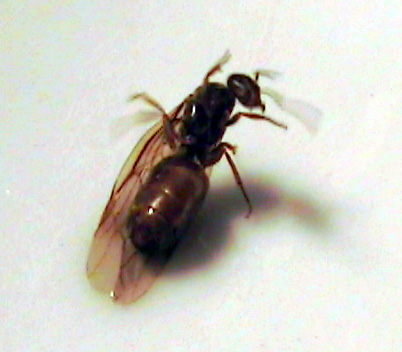 Flying Ant
 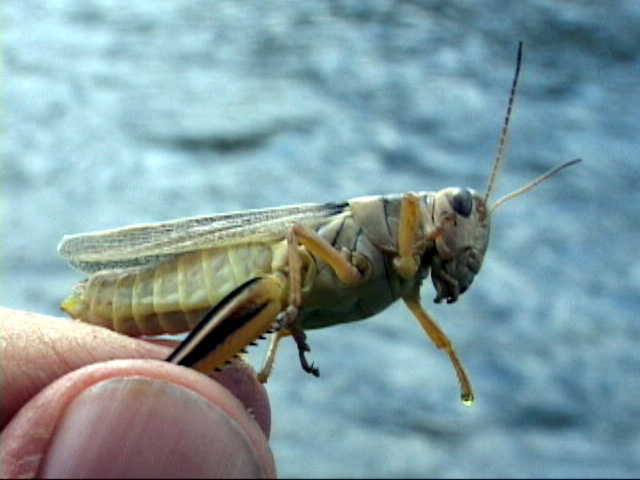 Grasshopper
 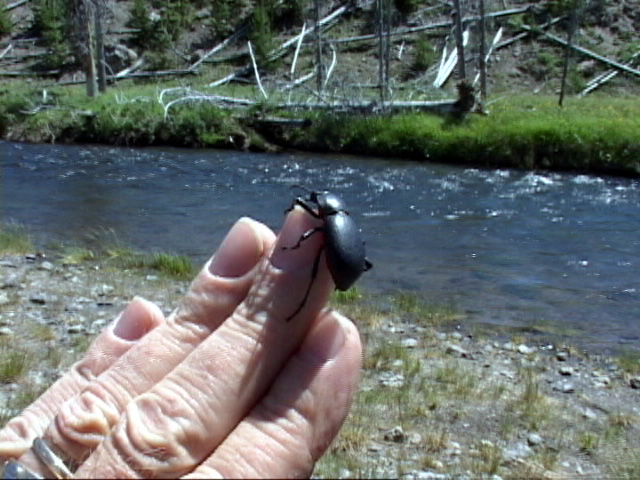 Beetle