Author: James Marsh

  • Fly Rods for beginners and some that thought they had the best fly rods.

    At Perfect Fly, we receive email and phone calls from people who want to get into the sport of fly fishing and want to know what fly rod they should buy. Those who have owned a fly rod for some time and can cast from twenty to seventy feet, probably already know what rod suits them the best. Those new to the sport of fly fishing, and even those who have been fly fishing for some time but have not developed their casting skills, just want to get most they can get for the money. Most of those new to the sport just don’t cast well enough to fairly judge the quality of a fly rod.

    Anglers who lack the skills to tell the difference between various rods are not capable of making the right decision when it comes to determining which one to buy. There’s a lot of marketing hype about fly rods as well as many anglers who consider themselves experts. Where does that leave a new angler looking for the right fly rod for them. Should anglers trust fly rod manufacturers to help them choose the right rod? Should they trust fly shop employees or guides? Many may have a interest in promoting a particular fly rod or a particular brand. Should they rely on the outdoor media?

    At Perfect Fly, we want to make certain the fly rod works out well for the new angler because we have a vested interest in it. We want them to continue to purchase flies, gear and equipment from us. Here’s my advice for new anglers, or less-than-good casters looking to purchase a rod that will meet their needs. First, you need to understand what the fly rod can and cannot do for you. Is a fly rod merely a tool to accomplish the task of catching a fish? Does the looks of the rod need to be aesthetically pleasing? Are you more focused on casting, or protecting light tippets, or fighting a fish as quickly and effectively as possible? You’ll also want to be honest with yourself. If you’re someone who puts a lot of emphasis on brands and labels, or who wants other anglers to admire your new rod, you should realize that can be a huge mistake. Do as much research as you feel is necessary but keep in mind that some people are better resources than others, and certain people will have an incentive to steer you in a particular direction.

    All of the points above, while helpful and important, are relatively standard. Here are some that are not so standard. If you’re a novice or intermediate angler, you should pay particular attention to how a company markets their fly rods. If they use terms like “fast” or “very fast” to describe a particular rod, that’s a red flag; a warning sign that the rod in question is probably not going to be a good fit for you. For the past several years, rod manufacturers have claimed that faster (or stiffer) rods are better rods. While that may be true in certain specific situations, and for certain casters, it’s not a true fact. Fast rods don’t flex easily, and they require far more effort to cast.

    If you’re a novice or intermediate angler, you should pay particular attention to how a company markets their fly rods. If they use terms like “fast” or “very fast” to describe a particular rod, that’s a red flag; a warning sign that the rod in question is probably not going to be a good fit for you. For the past several years, rod manufacturers have claimed that faster (or stiffer) rods are better rods. While that may be true in certain specific situations, and for certain casters, it’s not a true fact. Fast rods don’t flex easily, and they require far more effort to cast.

      Most of the work done with the rod is the result of rotation and not flex. But flex is what makes a rod pleasant, or unpleasant, to cast. Most rods made today feel terrible. If an angler buys a rod and is showing it off to his buddies, they can tend to make a lousy rod work. In fact, many have been doing that for years. After dumping a good bit of money on a rod, many tend to believe their bad rod is a good one. Many anglers, if not most, have never cast a pleasant-feeling rod.

      If you’re a novice or often make less-than-good cast, and if you’re in the market for a new trout rod, I recommend that you rule out fast action rods. Stick to medium, or moderate rods.

      If you already own a fast action rod, rather than putting them in the don’t use closet, try going up a line size with their fly line. Fish the rod with a one-size-heavier line. It won’t work for every rod — some models just won’t work well with any size fly line, but utilizing a heavier line can often help certain fast action rods perform better on the water.

      If you want to save money and get the best quality available for your money, try our Perfect Fly brands. We are able to save customers money simply because we have eliminated the “middle men”, or distributors and sales representatives. https://perfectflystore.com/fly-rods-combos/

    1. Some Perfect Gifts For Father’s Day

      June 6th is Father’s Day. Here are some gifts you may consider giving him.

      1. One of our new Euro/Nymph Rods: https://perfectflystore.com/product/perfect-fly-euro-nymph-fly-rod/
      2. One of our new Spey fly rods: https://perfectflystore.com/product/perfect-fly-spey-rod/
      3. Our full loaded Biddie Lanyards: https://perfectflystore.com/product/perfect-fly-biddie-fly-fishing-lanyard/
      4. One of numerous fly selections: https://perfectflystore.com/product-category/flies/perfect-fly-trout-flies/pftf-selections/
      5. One or more of our instructional fly fishing DVDs: https://perfectflystore.com/dvd-books-maps/
    2. Tips On Fishing Hatches

      There are times you may encounter a lot of different insects hatching and other times when there are few to nothing hatching. There are a few insects that hatch during the Fall and Winter. Most of them take place during the Spring and Summer months of the year. Of course, this varies greatly with the section of the country you fish.
           It is a fact that many anglers don’t really know how to go about fishing hatches, or for that matter, what is important about them. This isn’t going into any detail, or any specific aquatic insects. It is intended to point out just a few basic tips about how to go about fishing the hatches.
                1. Why Hatches Are Important
               When an aquatic insect hatches, it must come out of its hiding place – from underneath a rock, crevices between rocks, out of a grass or moss bed, or in some cases, a burrow. In order to hatch, meaning emerge into an adult insect, it must develop its wing pad and either accent to the surface, or crawl out of the water to emerger. It becomes directly exposed to the trout, or a sitting duck, you might say. The insects are very easy for the trout to acquire during the hatch. It may have to dry its wings in order to fly off the water. 
                2. What Flies Should You Have During Hatches?
                You should have flies that imitate all stages of life that trout eat of all the aquatic insects that may hatch while you are on the water. For mayflies, that includes nymphs, emergers, duns and spinners. For stoneflies, that includes nymphs and adults. For caddisflies, that includes larva, pupa and adults. For midges, that includes larva, pupa and adults.
                3. When To Fish Nymphs or Dry Flies (Below water or on the surface)
                I’m often asked, when to fish a nymph, or larva, or dry fly during a hatch. It depends somewhat on the particular insect, but in general, you should fish a mayfly or stonefly nymph, or a caddisfly or midge larvae during the morning hours, and a dry fly to imitate the mayfly dun, adult stonefly, or adult caddis or midge, during the afternoons. Early in the season, most of them hatch during the warmest part of the day. During the mid to late afternoon, most mayfly spinners return to the water to mate, deposit eggs and die. Caddisflies and Stoneflies usually deposit their eggs from the middle to late in the day.
                4. What Fly Should You Fish First?
               It depends on the time you start fishing, but always the one that imitates the most plentiful and available insect at the time. In the case of multiple hatches, and there is often more than one insect that may hatch the day you fish, and assuming you start in the morning, fish the nymph or larva of that insect, or in the case when other types of foods are plentiful and more available, such as terrestrial insects, crustaceans, or baitfish, fish imitations of that food. If you are not sure which food or insects are most available for a given stream and time, you can always email or call us at Perfect Fly, and we can help you.
                5. Where Should You Fish The Stream?
                Some trout streams are ninety miles or longer. Most all are at least five to ten miles. Whatever insects are hatching at the time, rest assured they are not hatching in the same place on the stream. They are usually hatching only in a small section of a stream ranging from a few hundred yards to maybe as much as five miles. In cases where the elevation of the stream changes a lot, they usually start at the lowest elevation and move upstream each day, remaining in one section for only a very few days.
                6. The Type of Water Is Also Important
                Different types of aquatic insects hatch in different types of water. Burrower, crawler, and swimming mayflies live and hatch in slow to moderate water. Clinger mayflies live and hatch in fast water. Stoneflies mostly all live and hatch in fast water. Caddisflies hatch in different types of water depending on the species. When you are fishing a stream and a certain insect is hatching, spend your time only in the type of water that insect lives and hatches in.
                There is much more you should know about hatches, but hopefully, these tips will help make your next trip more productive. Each of our Perfect Flies has a page of information under the info link on our website on how, when and where to fish them. If you are planning a trip and don’t know what insects are hatching at the time you will be fishing, send us an email, or call us and we will be glad to help you.
             email: sales@perfectflystore.com  Tel. 800 – 594 – 4726
           website: www.perfectflystore.com

    3. Hiding From The Trout

      If trout see you, it will be next to impossible for you to catch them. In order to hide from them, you need to know a little about how a trout sees the world outside the water. The subject is far too complicated to discuss in detail in a short article but thank goodness, it isn’t necessary. This issue has an article that gets into the trout’s window of vision and how they see things both under and above the
      water. For purposes of what I want to point out in this article, just a little common sense and a little basic knowledge about how trout see is all you need to help you prevent them from seeing you.

      Trout don’t see objects above the water, especially those at a distance, clearly. To make it simple, lets just say they see things as a blur. They cannot see anything in detail at a distance. A person standing twenty feet from them is just a blurred image. Now for those who want to get picky, what I am about to say isn’t exactly technically correct but I am not writing a scientific paper. I am describing how a trout sees someone trying to catch them. For all practical purposes, I am being accurate.

      What trout will notice, much quicker than anything else, is the movement of an object above the water. They are used to seeing blurred images of objects above the water that remain fairly still. Trees and boulders don’t move around a lot. Overhead predators pose a danger to them. Large birds and a animals pose a danger to trout. When something moves above the water, it gets their attention.
      The bottom line to this is that you should move as little as possible and when you do move, move as slowly as possible. Of course, it is difficult to cast without moving.

      The other thing about what they see above the water has to do with the distance the object is from them. To make this simple, due to refraction of light, they don’t see things that are low above the water. The higher the object, the easier it is for them to see it. For example, they could see an object ten feet above the water as far as twenty feet away but they would not see an object one foot about the water that is ten feet away. The lower you are, the closer you can get to trout without their
      seeing you. If you stand on top of the highest rock in the stream and look around you, chances are every trout within twenty or thirty feet of you will see you. Your movements climbing up on the rock and back down will spook them for sure. Stay low and slow, right the opposite of what you want to do if you are flying an airplane.

      Trout face normally face in an upstream direction. Their bodies and fins are streamlined for them to remain in current expending as little energy as possible. They would have a difficult time holding their position in current if they had their tail pointed into the current.

      Most all of their food comes to them in a downstream direction. Aquatic insects in a current seam are drifting downstream. The trout face in an upstream direction looking for them. The bottom line to this is that you can get closer to trout if you are downstream of them. If you fish in an upstream direction, they will not be able to see you as easily as they would if you were fishing in a downstream direction. With few exceptions I will not go into here, in the small fast water freestone streams in the Great Smoky Mountains, for example, you should always fish in an upstream direction.

      Trout don’t see the same way us humans do. They have a much wider peripheral vision. In other words they can see almost all the way around. Their binocular vision is not near as good as ours. That is part of the reason why they don’t see things at a distance above the water clearly and in great detail or resolution.

      Sounds simple so far. However, just because you are approaching them from their back side doesn’t mean you can slip up on them and tap them on their shoulders.

      As I have said, trout have a blind spot in their peripheral vision. It is a small area directly behind them. When they are positioned in the moving water of the stream facing in an upstream direction, that small blind area enables you to get fairly close to them provided you approach them from their rear. This must be done carefully and quietly. Approaching them from their front (the direction they are looking) isn’t as easy to do without being spotted.

      Again, it is movement of objects at a distance that gets their attention quicker than
      anything. Another big factor in just how well they can spot you has to do with your
      contrast with the surrounding background. For example, If you are wearing a white
      shirt and white hat, you are not blending in very well with the typical background of
      a stream unless snow is a foot deep. You want to blend in with the background in
      the same manner a deer or turkey hunter would. In fact, the best clothing you could
      possible wear would be the best matching camouflage outfits you could find to
      match the colors of the forest during the different seasons of the year. I am not
      suggesting you should go so far as to wear a camouflage net over your head or
      that you should shade your eyes. I am not even saying that camouflage clothing is
      necessary even though it would solve the problem very well. Trout will not detect
      your presence near as well if you blend in with the background. Subdued shades of
      browns and greens usually work best. You should avoid bright, flashy colors.

      Another factor in how close you can approach trout is how well you can see them. If
      there is a lot of glare on the water, and there always is, you should wear polarized
      glasses. There is no sense in stumbling over a trout directly in front of you. It will go
      upstream and warn its entire family that a creature is coming. Seriously, when trout
      suddenly shoot upstream, I believe it signals other fish that danger is approaching
      or it at least makes them aware something is not normal. The least fish you can
      spook, the better off you are, even if you are not trying to catch them.

      It helps if you can see what is ahead period. I don’t want to get into wading yet, but
      when you can see everything in the water ahead of you, you can wade making the
      least amount of disturbance.

      Trout do not have to see you in order for them to detect your presence. They can
      hear you. You can yell at your buddy and that won’t bother them. If you move a
      rock on the bottom of the stream, it will. If you stumble along the bank, it will disturb
      them. They can hear the sound you through their lateral line. Again, I don’t want to
      get technical. This is not the place to discuss how fish hear in detail. Just be aware
      that you should walk softly, without disturbing things on the bottom of the stream or
      the ground.

      Lets summarize what I have said so far about hiding from the trout:
      1. Keep a low profile. I don’t mean crawl along the bank or even that you need to
      stoop low when you are wading. Just be aware that the higher you are, the farther
      away trout can see you. Don’t climb up on boulders and search the water for the
      trout. They are there. You are just warning them that you are there.
      2. Fish in an upstream direction. Whether you are wading or moving along a
      bank, progress in an upstream direction, not downstream. Cast in a general
      upstream direction, not downstream. You can get closer to the trout and they won’t
      see you as well as if you approached them when they are facing you.
      3. Dress to blend in with the surroundings. Don’t wear flashy or bright colored
      clothing.
      4. Don’t disturb the bottom of the stream or the ground along the banks.
      Trout can hear you. Avoid moving or kicking rocks.
      5. Wear polarized sunglasses. The better you can see what is ahead in the water, the easier it is for you to prevent spooking the trout ahead. If you loose your footing and step off into a deep hole you will spook every trout in the creek.If you really want to learn a lot about what spooks trout, and how well they can see and hear you, do right the opposite of what you should do. See how many trout you can spook. Spring creeks are perfect places to do this. It is easier for you to see the trout and easier for the trout to see you. You can see the reaction of the trout, whereas in freestone streams, trout can flee without you ever seeing them. We have experimented with this several times and I believe we have picked up a few things we would not have otherwise learned.

      The first thing I noticed was that when I was about 40 feet away in full view of a
      trout, yet not noticed by the trout to the point it would flee, I could wave my arms
      without spooking the trout. Waving my arms and fly rod didn’t seem to make any
      difference in the reaction of the trout. I would be well within its line of vision standing
      on a bank, not below it. If I started walking to my left or right, the same trout would
      shoot under the grass to hide. I think that was because they could not see my arms
      well enough for the movement to get their attention but when my body moved, they
      could see what was going on. That is only a guess. There is no real proof of that
      theory, of course. I tried the same experiment on several trout and the results were
      always the same. The movement of my body had a different reaction than the
      movement of just my arms.

      If I stayed low on the ground and slowly stood up within about twenty feet of a trout,
      I could get by doing so most of the time without spooking the trout. However, when I
      would do the arm waving deal, they would all take off every time. That told me that it
      was next to impossible to cast to a trout that close too me without spooking it if it
      was looking in my direction. It also told me that if you move very slowly the trout
      didn’t spook as much as they do when you make sudden movements.

      I could do the exact same thing, approaching a trout from its rear, and pull it off
      without the spooking the trout. The effects of the blind spot to their rear became
      very obvious.

      I have tried moving up on trout in spring creeks about every way I could think off.  I
      have been working on a DVD on fly fishing spring creeks now for about six years.
      That was the reason I was spooking trout rather than trying to catch them. I
      attempted to show, on camera, the different reactions from the trout for various
      scenarios. It didn’t turn out very easy to do, by the way. Some of the things I
      discovered fooled me, but in most cases I was able to guess what would happen.
      That makes me think common sense goes a long way in approaching trout.

      I have kicked rocks just to see the reaction of the trout. I have stomped the ground
      with my feet. I have yelled as loud as I can yell and done a number of sound test on
      trout in spring creeks. That did fool me. They can hear much better than I thought
      they could. I have also done these sound test in the smokies. You can drop a rock on
      another rock in the stream and send every trout in sight fleeing. Try that from one
      of the high banks along a stream and watch the reaction.

      Spring creeks taught me a lot about approaching trout. You must be able to do so successfully or you are not going to catch any trout. Blind casting is a waste of time in spring creeks unless you are fishing a riffle section of the stream. I love fishing spring creeks because it does teach you a lot about the reactions of trout and a lot about being able to fool and catch them. Spring creeks are perfect places to learn how trout react to movements and sound. You can clearly see what spooks away with. You must stalk trout to catch them. You do not blind cast because you can see everything in the water. I

      For an example, let’s consider Silver Creek Idaho, one of our favorite streams. We have fished this beautiful creek several times and we have learned a lot about trout doing so. You rarely catch a
      trout you don’t first see. If the wind is not blowing hard, you will be looking at the trout you
      are casting to every time. Knowing what spooks trout, what you can get away with and what you can not get away with, goes a long way in being able to catch them.

      We learned that the surface of the water makes a huge difference in what the trout can and cannot see above the water. If it is smooth without ripples, you are seen by the trout much farther away than you are seen when the surface of the water is disturbed by current or wind. That is another reason you can get closer to the trout in riffles and runs than you can in the smooth water of a pool or pockets along banks and behind boulders in the Smokies.

      Fish holding in deeper water will spook much quicker than those holding just under the surface. I think this is to do with their window of vision but it could also be a result of what the trout are concentrating on. When they are only inches deep feeding in current, they are looking for tiny insects. You would think they would be keenly aware of what was around them since they are in an exposed position but
      they don’t spook as easily as they do when they are holding in water a couple of feet deep. When they are holding inches under the water, they don’t see insects in the water until they are within inches from their nose. This is due to their small window of vision.Reviewing the Basics – Hiding From the Trout – WadingWading can help you catch more trout in the small streams of Great Smoky
      Mountains National Park in some cases, but before I discuss when and where it can help you, let me give you a fair warning. Wading can also prevent you from catching trout in the Smokies. It is an easy and fast way to spook trout. The trout can see you under the water and above the water. They can hear your boots scrape the bottom or move some sand and gravel. If you are in calmer water such
      as a pool, your wake can spook trout. Never wade unless it is necessary for you to get into position to make a presentation to areas of the water you think are holding trout. If you can reach those areas and get a good drift from the bank, by all means do so. Every time you wade you are taking chances on spooking some trout that you may have been able to catch from the bank.

      The problem with everything I have said so far is that it is often and very common that you will not be able to present your fly to areas of the stream that are likely holding trout without wading. One thing that makes it almost impossible to cast from the bank is the heavy growth of trees and bushes along the banks of the stream.
      There are nine different species of rhododendrons that live in the park and many of them completely enclose the small streams.  In many areas there is timber growing right up to the banks of the streams. This is great because if it did not, the streams would not have the trout that live in them. The water would be too warm in most areas for trout. They do keep you from casting along the banks in many cases.

      Now don’t take this wrong. Just because there are some trees along the bank don’t mean you can’t cast from the bank. You can make all kinds of creative cast if you try and learn to make them. When you can, be certain to fish the water near the banks before you get into the water to wade. About the biggest mistake you can make is just to walk up to a stream, wade out into the center and start casting. You may have spooked some trout right where you headed into the stream. Always
      take you time.
      Stop and look at the water. Figure out your best approach to get to the likely holding and feeding areas you intend to cast to.

      I am not the best person in the world to give out this tip but I will anyway. Never cast while you are taking steps wading. You can’t concentrate on both and you will eventually end up making bad cast or tripping, stumbling or even falling. Stop casting and look at the water where you are wading. I am often guilty of making this mistake. I catch myself doing it and stop, then forget and do it again. I have also
      busted my you know what a few times – casting when I was wading. I hate to admit this one, but I slipped off a rock on the bank in a hole under the heavy cover of rhododendron bushes along Little River one time, got wet to the bone, could have drowned and lost my fly rod, reel and line. The water was fairly high, I was looking at a good size brown trout a few feet upstream and was determined to cast to it. I didn’t look where I was stepping. I was too concerned about casting. It knocked the
      breath out of me and turned my back black and blue. When I looked up my rod was not in sight.

      The bottom line is wading can be dangerous. Never wade when you question the water depth or speed. Use the knee deep rule. Don’t wade water over knee deep. Stop casting when you move and look at the bottom ahead. Move slowly. There is no need to rush. Everyone has to get used to wading the water. The more you wade, the easier it is to do. It also takes some leg muscles if you do
      very much of it. Climbing up and down and over rocks gives you legs a good workout. The water resistance in the current and weight of the waders and boots will tire you out until you get used to it. Never wade when you are tired. That is a huge mistake. If you are tired and give out and you have a problem such as slipping and falling, you do not want to be tired.

      Wear a wading belt tight around your waist. If you fall in the water, it will run
      down into your waders filling them with pounds of water. Try standing up with your
      waders full of water. The wading belt will keep your legs and waste from filling up
      with water. I fell in the Madison River one time, just above the two dollar bridge. I
      had a big rainbow on that I actually ended up catching, and was moving
      downstream with the trout wading when I stepped off into a deep hole. I went
      completely under the water except for the very top of my head. I have no idea how
      or even why I held the fly rod. I almost did not get up because the current carried
      me about ten yards downstream as I fought to regain my footing. I am totally
      convinced that if I did not have my wading belt on, I would have drowned. The entire
      episode is on video tape. I will never forget it. It took every ounce of energy I had. I
      should have dropped the rod and I have no idea why I didn’t. When I caught on and
      got back up, it dawned on me I still had the fly rod and when I tightened the line, I
      found the trout was still on. It was a solid eighteen inches long. A bridge full of
      vehicles also watched that little episode. Angie was running the camera from a
      tripod and was screaming to the top of her voice. She could not have possible
      helped me. I did a stupid thing, wading in deep, swift water. I did one thing right that
      I think saved my life. I had my wading belt on tight. From my waist up, I had a lot of
      water to deal with. I don’t think I could have handled the current if my pants legs
      filled up. Wading is dangerous. Several anglers have died from mistakes. Many of
      them were below dams but some of them were in other types of streams.

      I got off course with safety but it is very important.

    4. June 2014 Perfect Fly Journal

      Welcome to the new June 2014 Issue of the Perfect Fly Journal. When the subject of fishing comes up, the concerns of most anglers, especially those without a lot of experience, gets down to the subject of how, when and where to catch more fish. This issue contains three articles we think will be of help in that regard.

      1. How Trout See Flies: https://perfectflystore.com/how-trout-see-flies/

      2. Hiding From Trout: https://perfectflystore.com/hiding-from-the-trout/

      3. Tips on Hatches: https://perfectflystore.com/tips-on-fishing-hatches/

      4. Best Fly Rods: https://perfectflystore.com/wp-admin/post.php?post=36941&action=edit

      5. Some Recommended Gifts for Fathers Day: https://perfectflystore.com/some-perfect-gifts-for-fathers-day/

    5. How Trout See Flies

      In order to understand why trout will take a particular fly at certain times and
      places and not take it at other times and places, you first must understand the
      basics of how the trout sees a fly and what triggers the trout into taking the fly or
      ignoring it.  The same basic knowledge is necessary in order to understand why
      generic, attractor and impressionistic imitations work at certain times and places
      and don’t work at other times and places. The same is true of when, where and
      why specific imitations are more productive than generic or attractor flies. You
      cannot possibly understand it without knowing at least some of the basics of the
      trout’s senses and behavior. Keep in mind that this is about specific imitations
      (flies that imitate a specific insect at a specific stage of life) versus generic
      imitations (attractor or impressionistic flies that imitate a variety of insects or
      other trout food). It is not about one fly pattern versus another fly pattern.

      Trout learn from birth to accept and reject various objects in the streams as
      food. They never eat something they don’t take for food. Even though they have
      very tiny brains and even by the stretch of one’s imagination are not smart, they
      can still learn by experience. They do not depend on intelligence as much as
      they rely on senses and instincts to eat.

      Feeding Zones:
      Trout have the ability to hold in slow to moderate current without swimming or
      expending a great amount of energy. They manage to do this a lot like birds do
      when they are gliding in the wind without moving their wings. When they are
      feeding, trout find the areas where the current concentrates the insects. Anglers
      call these places drift lines. Trout will position themselves somewhere along
      these drift lines. There they will hold their position and stay focused on what is
      referred to as their “window of vision”. They must seek an area of the stream to
      hold in where the current is not strong. If they didn’t they would expend more
      energy than they could take in. Most often, they accomplish this by seeking a
      depth where the current is slowed down by obstructions upstream, usually rocks
      and boulders. Sometimes they are able to position themselves on the slow side
      of the drift line. The current in the drift line above or to the immediate side of the
      trout may be moving along rather fast but the trout is usually positioned in slow
      to moderately moving water where they can view objects that come into their
      window of vision. If that food is in the form of nymphs, larvae or pupae drifting
      underwater, then the distance at which the trout can view it depends on several
      factors. The underwater background, amount of available light, clarity and speed
      of the water are just a few of them. Normally, in very clear water with good light,
      they are able to detect the movement of objects that are within several feet of
      them. Objects on the surface are viewed entirely different.

      Window of Vision:
      You may hear anglers say “the trout were not looking up today”. I assume they
      mean that as a figure of speech because trout are always looking up. Unlike
      humans, they see almost all the way around themselves. Also, unlike humans,
      trout can focus at extremely close ranges. They can focus on a fly that is only an
      inch or less from their eyes. However, at long ranges they cannot focus well
      enough to discern the details of objects in the water.
      Without going into unnecessary detail regarding the physics of light, lets look at
      some facts that affect the trout’s vision of your fly. The “window of vision” as it is
      called, is the area of water on the surface above a trout where they can clearly
      see objects. Trout can see objects on the surface that are directly above them. If
      the surface of the water is smooth or not rough, they can see objects directly
      above them that are above the water. However, there is a point above them at
      which their line of sight will not pass through the surface of the water. It is exactly
      48.5 degrees from a point at which a vertical line extends from a trout’s eyes to
      the surface of the water.  This means that they can see through the surface of
      the water in an area formed by a 97 degrees cone. This cone looks like an
      upside down snow cone cup with the point of the snow cone extending from the
      trout’s eyes up to the surface of the water. Using this analogy, if the circle of the
      cone (or top of the upside down snow cone) was even with the surface of the
      water, it would be referred to as the window of vision.
      The trout sees everything that is outside of that cone as a mirror image
      of the underwater surroundings.
      The deeper the trout, the larger the window
      of vision is at the surface of the water. If the trout is only a couple of inches
      deep, the window of vision is just over four and one-half inches in diameter.
      If the trout is two feet deep, then the diameter of the window of vision is just over
      four and one-half feet in diameter. In other words the trout can see objects at
      the surface of the water just over two and one-half feet in front of, two and one-
      half feet behind and two and one-half feet on either side of their position. A fly
      on the surface of the water passing over the trout can only be seen by the trout
      for a total distance of four and one-half feet or the diameter of its window of
      vision.
      This window of vision is caused by light refraction. Stick the tip of you fly rod
      down into the water at an angle. Notice the rod appears to bend at the point it
      penetrates the surface of the water. This optical effect is caused by the change
      in speed of light as it goes from one transparent medium to another or air to
      water.
      Sometimes trout will hold just a few inches under the surface where they can
      closely inspect their food and at the same time, expend only a small amount of
      energy eating. When they are only a few inches deep, the depth of focus only
      allows them to see objects that are within a few inches of them. In other words,
      when they are holding this shallow, their feeding lane is only a few inches wide. If
      a dry fly passes by several inches away, to their left or right, they may not even
      see it. On the other hand, if the trout is three or four feet deep, the depth of
      focus is much greater and it has a much larger feeding lane. Although trout can
      focus in almost every direction at once, they cannot focus on an object that is
      three feet from them the same way they can one that is inches away.
      When objects on the surface or beyond first appear in the window of
      vision or come in view on the outermost edge of the circular window,
      they appear much shorter and wider than they actually are.
      The more they
      approach the center of the window of vision, the more they appear like they
      should. Objects directly overhead appear exactly as they should. That means
      that the appearance of your fly is changing as it comes into the window of vision
      from being short and wide to actually looking like the real thing.
      Now don’t misunderstand this to mean that since the trout sees a distorted view
      of your fly when it enter the window, that its appearance of your fly is not
      important because they see the real insects on the surface in the exact same
      manner. They too appear short and wide near the perimeter of the circle. So it is
      still a fact that the more your fly looks like the real thing, the more the trout are
      likely to accept it for the real thing.

      Surface Film:
      The cohesive forces between liquid molecules are responsible for the
      phenomenon known as surface tension. A surface “film” is formed which makes it
      more difficult to move an object through the surface than to move it when it is
      completely submersed. If an insect is perched on the surface film its six legs
      and/or other portions of its body may protrude through the film. The parts of
      the insect or fly that extends below the surface can be seen by the trout
      even when it is outside its window of vision.
      Seeing the legs of an insect or
      other parts of its body may alert the trout that something is coming into its
      window of vision. A midge may make such a sight indentation in the surface film
      that would be almost impossible to see outside the window simply because the
      parts penetrating the film are so tiny. A grasshopper’s legs and maybe even part
      of its body would be visible outside of the window from much farther away. I
      could go on and on explaining light refraction, Snell’s Law and just how it affects
      the trout’s vision of the fly but I would be getting away from some of the main
      points I want to make.
      When a trout sees an insect on the surface that has drifted into its window of
      vision, it determines whether or not to take the insect. If the trout attempts to
      take the insect, it moves its fins in such a way that allows the current to assist it
      in propelling its upward motion. It takes the insect in its mouth and then moves
      its fins in such a manner as to propel back down into its holding position.

      Binocular and Peripheral Vision:
      When us humans look ahead, our field of vision allows us to see thing that are
      within a 176 degrees area called the “field of vision”. Our forward zone of
      binocular vision is 90 ninety degrees or forty-five degrees on either side of a line
      straight ahead. The portion of our vision that is outside of that 90 degrees zone
      of binocular vision represents the area of our peripheral vision. Our peripheral
      vision represents a total of 86 degrees or 43 degrees on each side of our
      binocular vision.
      To illustrate this, place your finger about two feet directly in front of your face
      and focus on it. Now continue to look directly forward and move your finger to
      your left until you cannot clearly see it in focus. You should be able to see it
      clearly until it is 45 degrees left or right of straight ahead. The area in which you
      are able to see it clearly is the area of your binocular vision. If you continue to
      move it left up to 15 more degrees you should still be able to see the finger but
      your cannot see it clearly or in focus. This area represents the area of your
      peripheral vision. Of course things work the same if you move your finger to the
      right.
      Trout have a much narrower width of binocular vision than humans. The trout’s
      binocular vision allows them to only focus on things that are within a total of 30
      thirty degrees directly ahead or fifteen degrees on either side of a line directly
      forward of their eyes.  However, they have a much larger field of vision than us
      humans. It is a total of 330 degrees or represents an area almost completely
      around them. Of that 330 degrees field of vision, their zone of peripheral vision
      represents 300 degrees of it or 150 degrees on either side of their narrow 30
      degrees binocular zone. When they detect something with their peripheral
      vision, they must move their eyes towards the object in order to focus on it.
      There is only an area of 30 degrees directly behind a trout that is not visible to
      them. This narrow area is commonly referred to as their blind zone. The bottom
      line to this is that although trout can detect movement and contrast
      almost all the way around themselves they must look almost directly at
      an object, or align the object in their narrow 30 degrees field of
      binocular vision, in order to clearly see it.
      Binocular vision is necessary for the trout to see things in detail. It is necessary
      for a trout to feed. Peripheral vision is great for detecting movement and
      contrast but things within the trout’s peripheral vision cannot be seen in detail.

      Light Effect:
      The amount of available light also has a huge effect on how a trout sees your
      fly. Their iris is not adjustable. It is fixed and cannot be enlarged or reduced.
      This means that they cannot control the amount of light that enters their eyes
      with the iris. Rods and cones allow them to adjust to various light intensities.
      Trout can detect color and very fine detail but bright sunlight can eliminate the
      color that enters their eyes. By the same token, under low light conditions such
      as when it is early in the morning, late in the day or at times when the sky is
      dark, they cannot see the colors of the fly and well as they can in a well lit
      situation. Light doesn’t penetrate very deep in water and the depth of your fly
      also affects how the trout sees the color of it. If the trout is deep in the water,
      flies that are floating on the surface will not be viewed in the their true colors.
      The trout must get closer to the fly in order to see it in true color. The bottom
      line to this is that under many different lighting conditions, they cannot see the
      fly very well at all. But the amount of light is not the only factor in how well a trout
      sees your fly. There is yet another, far more important factor, in how well the
      trout sees an insect or fly. It is the speed of the water and insects or flies that
      are drifting in it or floating on it.  

      Speed of the Water:
      Now lets discuss another, huge factor is how well a trout is able to see an insect
      or your fly – the speed of the water. In fast moving water with a broken surface,
      the trout must make a very quick decision as to whether to take or reject a fly.
      The speed of the water doesn’t just apply to flies drifting on the surface of the
      water. The same thing applies to a nymph or larva moving through the water. In
      fast moving water, the trout cannot take their time in deciding whether or not to
      take the fly.
      The speed of the water is the number one reason trout can be fooled by
      generic, impressionistic or attractor type flies.
      In fact, if the water in the
      current seam is moving fast enough and the trout are holding fairly close to it,
      they can often be fooled by a fly that doesn’t resemble much of anything they
      have ever seen before. Due to the factors I have mentioned above and the fast
      speed of the fly they don’t have much opportunity to examine anything.
      In smooth, slick water where the current is moving at a slow rate, the trout has
      plenty of time to make a very close inspection of your fly. For years I have said
      that you want a fish to see any artificial bait or lure just well enough to think it is
      a real creature but not well enough to determine that it isn’t. In other words, you
      want them to be able to just barely see it – just enough for them to think it is the
      real thing. The same thing is true of flies. It doesn’t matter if it is a twelve-inch
      long marlin lure, jumping in and out of a wave in offshore blue water; a crankbait
      passing by a bass in dingy water, or a fly passing by a trout in clear water. You
      want the fish to see the artificial imitation only well enough to fool it into thinking
      it is the real thing. The more the lure or fly looks and acts like the real thing, the
      longer you can allow the fish to examine it. In other words, the slower it can pass
      by the fish. Notice I said “acts” like because that is even more important than
      “looking like” whatever you are trying to imitate. A solid brass nymph cast to
      perfection exactly like the real thing won’t fool a trout very well. It’s abdomen,
      gills, legs and other body parts will not move and act like a nymph.
      When you are fishing for trout with flies, the faster the water is moving, the
      easier it is to fool them. When trout can only get a quick glimpse of the fly they
      are much easier to fool than they are when they have a lot of time to closely
      examine the fly. This is especially true when it passes by at close ranges where
      they can really focus on the details of it.

      Smoky Mountain Streams:
      Now so far, when you are fishing the fast water freestone streams of the
      Smokies, everything sounds great and in favor of using generic, impressionistic
      and attractor flies. I have just explained in detail the main reasons trout
      can be fooled into taking attractor flies for real insects.
      The typical Smoky Mountain angler makes all of their presentations in the fast
      water of runs and riffles. The biggest decision made is whether to fish a dry fly
      on the surface or a nymph below the surface of the run or riffle. If they don’t get
      them on one or the other type of attractor or generic flies in the fast runs and
      riffles, they excuse their performance by declaring that fishing is poor. Poor
      success usually occurs when the trout are not feeding in the fast water
      of the runs and riffles.

      Where Trout Feed When There Is No Hatch to Match:
      First of all and most importantly, trout do not always feed in the faster moving
      water. They often feed near the bottom in slow to moderately moving water.
      They sometimes feed in pools. When the water is fairly cold, they almost always
      feed in very slow moving water.
      In cold water, since most of the faster moving water in the freestone streams of
      the Smokies is near the surface, they choose to locate in the lower or bottom
      sections of the stream where the water is moving much slower to feed. Many
      anglers think they position themselves on or near the bottom to get warmer.
      Trout are cold blooded and do not seek warmer water for comfort. They seek
      the slower moving water to prevent spending more energy than they can take in
      from food in the cold water. Besides, the water temperature changes little if any
      with the depth of the streams.
      Larger brown trout do not feed on crawfish and sculphin in fast water. They eat
      them in slow to moderately moving water on the bottom either under low light
      conditions or from an ambush position.
      Terrestrial insects are eaten wherever they happen to fall in the water. More
      often than not, this is near the banks and often in slow moving water.

      Where Trout Feed During Hatches:
      Where do the trout feed during aquatic insect hatches? For example, where do
      midges hatch and the trout feed on them?
      Answer: In the slow moving water such as eddies, calm pockets and the slow
      moving water of pools.  
      Where do most mayflies hatch?
      Answer: Even the clingers that live in the fast water runs and riffles move to the
      slow moving water of calmer pockets and shallow water that is near banks and
      behind boulders to hatch. Just about all the crawlers and swimmers move to slow
      to moderately moving water to hatch.
      Where do the spinners fall?
      Answer: Usually in the riffles and runs where they hatched but they are eaten by
      trout in eddies, calm pockets and the slow water at the heads of pools where
      they collect.
      Where do the stoneflies hatch?
      Answer: They move out of their fast water habitat into slower, shallower water to
      hatch on the banks and rocks.
      Where do the caddisflies hatch?
      Answer: They just about always move to the slow to moderately flowing water for
      their pupae to emerge.

      In other words, about everything that hatches does so in moderate to
      calm water.
      Often this slower moving water is very close to fast water. Often the
      calmer water is in pockets distributed throughout the stream within the fast water
      of the stream. Sometimes it is the ends of long runs where the water slows down.
      If the newly hatched insect stays on the water and doesn’t fly away quickly it will
      most likely be caught up in the fast currents. It depends on the species hatching.
      Some never get caught in the fast water. Examples are stonefly nymphs that all
      crawl out of the water in calmer areas. Slate Drake mayflies that crawl out of the
      stream in calm water to hatch. Blue Quill and Mahogany Dun mayflies almost
      always hatch in calm pockets along the banks and usually never get caught up
      in fast currents before they fly away. Many species of Blue-winged Olives, Little
      Blue-winged Olives, Small Eastern Blue-winged Olives and Eastern Blue-winged
      Olives are able to depart the water from calmer sections or moderately moving
      water before getting caught up in fast water.  
      Some mayflies do usually get caught up in fast water before they are able to
      depart the water. Quill Gordons and March Browns hatch in calm pockets within
      the fast water areas of the stream but often get caught in the fast currents prior
      to departing the water. However, the facts are that most hatching aquatic
      insects and egg layers do not usually get caught up in the fast currents.
      When trout feed in the slow to moderately flowing sections of the streams; or
      eddies, pools, the ends of runs and riffles and calm pockets that are within the
      fast flowing freestone streams, they can examine the fly much closer. Given that
      opportunity, if the fly is not very imitative of the natural insect and if it is
      not presented in such a manner as to behave like the natural insect, the
      trout will usually reject the fly.
      As I just touched on, the problem isn’t just a matter of how well the imitation looks
      like the real thing. The way in which it is presented may be an even bigger
      problem. You have probably heard over and over that the presentation of the fly
      is more important than the fly itself. That is a very correct statement but it doesn’
      t mean that the fly is not important. It just means that a perfect imitation is not
      effective unless it is presented to the trout in the same manner they view the real
      thing. The fly must drift and act like the real thing without the trout being able to
      become alerted or alarmed by a tippet, fly line or leader attached to it. Again,
      that is fairly easy to accomplish in fast moving water but again, that is not always
      where the trout are feeding. The presentation and the appearance of the fly
      become even more critical in slow or moderately moving water.
      When anglers concentrate only on the fast water of riffles and runs they are
      making a big mistake.

      The Big Misconception:
      When there is no hatch occurring (which is 98% of the time) anglers tend to
      think they are better off using an attractor or generic imitation that imitates a
      variety of things. A fly that imitates no specific insect but rather a variety
      of them works best when environmental conditions (water temp,
      oxygen, stream levels, etc) are near perfect and lots of insects are
      readily available for the trout to eat.
      In other words when anyone that can
      cast a Royal Humphy twenty feet upstream in a run can catch trout. When you
      can hit them over the heads with the line and they still will eat the fly, a Royal
      Wulff works great. When there is little challenge in catching trout most anything
      made of feathers and hair with a hook in it will produce some good results.  
      This big misconception came about because book after book about
      trout fishing lumped things into one of only two categories – selective
      feeding or opportunistic feeding.
      Most anglers think that trout are feeding
      either one way or the other. It is true that if trout are not feeding exclusively on
      one insect, they are categorized as feeding opportunistically, so by strict
      definition, I suppose they are. That is fine as far as categorizing them is
      concerned but it has little to do with what is really going on and it is of little
      information or use in catching trout.  

      For example, lets suppose that there are lots of Little Yellow Stonefly nymphs
      crawling to the banks to hatch. Don’t think the trout don’t know it. They view their
      underwater world 24 hours a day and they know and see exactly what is going
      on. Since these nymphs are crawling across the bottom to get to the banks, they
      are easy prey for the trout. Naturally, the trout will focus on feeding on the easy
      prey.
      If the trout are eating these nymphs migrating to the banks and a stray mayfly
      nymph happens to come along, the trout may or may not eat it. Most likely, if the
      trout does not have to go out of its way to do so, it may very well feed on the
      mayfly nymph. If it takes more effort than it does to catch another stonefly nymph
      crawling to the bank, it most likely won’t eat it. Lets suppose a trout did eat the
      mayfly nymph. By definition you would have to categorize the trout as
      feeding opportunistically.
      That is why marine fishery biologist classifies all
      trout as opportunistically feeders. It makes sense from a scientific
      standpoint but little sense from a practical standpoint of catching fish.
      A
      particular trout may be feeding selectively at the same time one a few feet away
      may be feeding opportunistically. One run or riffle may have several trout that
      are feeding selectively at the moment when another run or riffle a few yards
      upstream may not.
      Call it whatever you prefer to call it. Under these conditions, would you
      rather be fishing an imitation of a stonefly nymph or a mayfly nymph?
      I
      think most anglers would agree that your odds would be greater if you were
      fishing an imitation of a Little Yellow Stonefly nymph.  

      The Bottom Line:
      You are always better off using specific imitations
      ( a fly that imitates a
      specific insect at a specific stage of life) to imitate the behavior of the
      insects or other food the trout are most likely eating at the particular
      time and place. Unless a substantial hatch is underway, this would most
      likely be the food that is most plentiful and easiest for the trout to
      acquire.

      Example One:
      Lets suppose it is the first day of March and nothing is hatching. Everyone
      knows that the Quill Gordons and Blue Quills will start to hatch any day.
      However, this particular day the water will only reach a high of about 48 degrees
      F. In other words, it is still a little too cold and maybe a little too early for the
      hatches to start. Under these conditions, the Quill Gordon clinger nymphs have
      already begin moving out of their fast water habitat of the runs and riffles into
      nearby slower moving water, mainly pockets behind large rocks and boulders.
      The little Blue Quill crawler nymphs have began to move from their moderate
      water habitat to slow moving water to hatch, usually along the edges of the
      stream in calm pockets of water. There are no mayflies hatching on the surface.
      The streams are full of nymphs and larvae because most everything is yet to
      hatch. That is most everything except the Little Black Caddisflies. They have
      formed their pupae and are hatching during the warmest part of the day, usually
      mid afternoon. Shortly thereafter the females will begin depositing their eggs
      over the same water they are still hatching from. Most anglers are either not
      fishing, fishing a generic nymph in the fast runs and riffles or fishing a dry fly
      Quill Gordon or Blue Quill imitation. Most are catching few trout and most are
      complaining that the water is still to cold for “good” fishing.
      If you were fishing this hypothetical day during the morning and up to the
      warmest part of the day, a good choice would be to fish an imitation of the Quill
      Gordon clinger nymph in the pockets behind boulders and large rocks. A flat
      nymph, hock size 14 heavily weighted would be a good choice. You would make
      short up and across presentations on the swing or “high stickin” presentations.  
      Another option would be to fish an imitation of the small Blue Quill nymphs along
      the edges of the stream in slow to moderate water. A good choice would be a
      slim, narrow clinger nymph imitation, hook size 18. You would want a long leader
      and light 6X tippet. You would make longer than normal upstream cast into
      shallow water along the banks. You would make very careful approaches to
      keep from spooking the trout that may be holding in the nearby the shallow
      water.
      Later in the mid-afternoon, you would want to switch to an imitation of the Little
      Black Caddisfly pupae in the moderately flowing sections of the stream such as
      the ends of the long runs and tailouts of the pools. This would be a hook size 16
      imitation of the Little Black Caddisfly pupa. You would present it up and across.
      Later in the afternoon, when you started seeing the caddis deposit their eggs
      you may want to switch to a dry fly imitation of the adult Little Black Caddis. A
      black Elk Hair Caddis, hook size 16 or 18, should work fine.
      Using the strategy I just outlined and fishing imitations of the specific
      aquatic insects
      I just mentioned would greatly increase you odds of catching
      trout this hypothetical March first day.
      In fact, this past early March (I am not certain of the exact day but under the
      same circumstances) Angie and I caught over twenty trout in Little River in
      less than three hours of fishing when everyone else we talked to
      caught few or none.
      The “fishing reports” all labeled things as “fair” with an
      “any day now” tag to it.
      All of the fish were taken within the first half-mile of water below the turn from the
      main road to the Elkmont Campground. We did exactly what I described above.
      We started fishing about 2:00 o’clock in the afternoon and fished our own
      “Perfect Fly” imitation of a Quill Gordon nymph. When we didn’t catch any fish,
      we changed to a Blue Quill nymph imitation (a Shane Stalcup swimming nymph
      pattern) and caught a couple of nice rainbows in very shallow water along the
      bank. When we noticed the Little Black Caddisflies were hatching (about 3:00 o’
      clock) we changed to a caddisfly pupa imitation (Orvis model if I remember
      correctly) and caught most of the fish we caught during the next hour. About 4;
      00 o’clock we changed to a plain black Elk Hair Caddis. During the next hour, we
      caught a few more trout. We stopped fishing about 5:00 o’clock, which is fairly
      early in the afternoon when the egg laying process was still underway.  
      That is not the only time we have been able to accomplish this early in the early
      season leading into the Quill Gordon hatch. We have done that several times
      during the last three years using the same basic strategy. In most cases, we are
      able to catch trout on the Quill Gordon nymph just prior to the hatch. The Blue
      Quill nymph works great but is difficult to fish in shallow water edges of the
      stream. You will spook a lot of fish trying to make a good presentation along the
      banks under the trees.  
      Again, the point is unless conditions are prime and multiple hatches are
      occurring, you are always better off using specific imitations of the most
      prevalent insects than you are using a generic or attractor flies. Attractor and
      generic imitations usually work fine as long as conditions are prime and there
      are multiple choices of food available for the trout to eat.  

      Summary:
      1.        The trout’s “window of vision” on the surface of the water is relatively
      small. Insects and flies pass through it quickly, especially in fast water.
      2.        While they can see movement and contrast most all the way around
      themselves, they only see objects clearly when they directly face the object to
      align it in their narrow area of binocular vision.
      3.        Attractor or generic flies usually work okay in fast water where the trout
      have little time to examine the fly, but trout don’t always feed in fast water. Day in
      and day out, most of the time, they feed in slow to moderate water.
      4.        Attractor or generic flies work best when environmental conditions (water
      temperature, oxygen content, water levels, etc.) are prime and multiple hatches
      are underway. Simply put, when hungry, aggressive trout have a lot of food to
      choose from. When it is easy to catch them.
      5.        Trout do not have to be feeding “selectively” to be focusing on or keying
      in on a particular insect. Most of the time they are feeding they are focusing on
      one or no more than a very few insects. Call it opportunistic feeding if you like.
      Regardless of how you label it, they are going to feed mostly on the insect or
      insects that are most abundant and easiest to acquire at the particular time and
      place.   
      6.        You are always better off using specific imitations to imitate the behavior
      of the insects or other food the trout are most likely eating at the particular time
      and place. Unless a substantial hatch is underway (to repeat the most
      important point again) this would most likely be the food that is most
      plentiful and easiest for the trout to acquire.


      Coming Up:
      In the forthcoming articles (as I have time to write them) I will give several other
      examples of how specific imitations of the most prevalent insects outperform the
      use of attractor or generic flies. I will use hypothetical scenarios and actual
      examples of success we have experienced during those times generic fly
      patterns failed other anglers fishing the Great Smoky Mountains National Park.

    6. Perfect Fly – February, 2023 Fly Fishing Journal

      Contents

      1. Great Smoky Mountains National Park – Top Two Streams
      2. Yellowstone National Park – Top Two Streams
      3. Fly Fishing Tailwater Streams
      4. New Euro nymph/Hi-sticking flies
      5. New Perfect Fly Euro/Nymph Fly Rod Series
      6. New Perfect Fly Spey Fly Rod Series

      Great Smoky Mountains National Park-Top Two Streams

      You are probably wondering why we choose to list the top two streams instead of the top stream. That’s because about half of the park is in the state of North Carolina and half in the state of Tennessee. https://www.flyfishingsmokymountains.com/

      Angie Marsh fishing Little River which is on the Tennessee Side of the park.
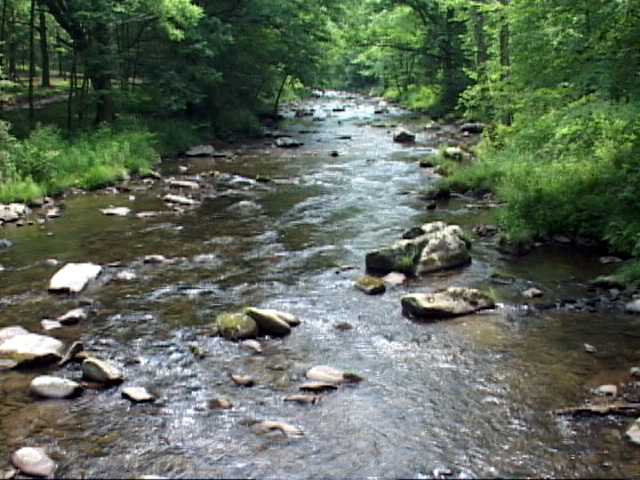
      The Tennessee side of the park is blessed with several different streams that provide year-round fly fishing opportunities. Little River has both brown and rainbow trout in the middle and lower elevations and brook trout in the upper sections. We will label it the best one on the Tennessee side of the park but the choice is very debatable. There are other streams that provide very good fly fishing opportunities.

      There are three prongs of Little River – the East Prong, West Prong and Middle Prong. They are really three entirely different streams that flow together near the entrance to the park near Townsend. We are referring to the East Prong which is the largest of the three prongs. Much of the stream is easily accessed from a paved road that closely follows the stream from its lower portion all the way past the Elkmont Campground; however, there are several miles of the stream above Elkmont accessed only by tail. There are several small tributary streams that provide more small stream fishing opportunity that flow into the upper segment of Little River above Elkmont Campground. The various sections of Little River can be easily accessed from Gatlinburg, Townsend and Cades Cove.

      Hazel Creek which is on the North Carolina side of the park.
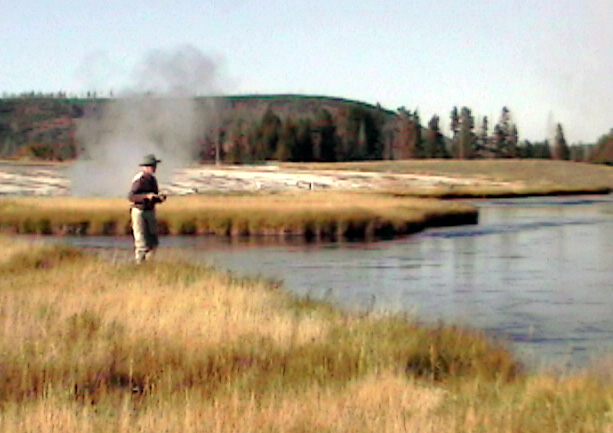
      This is considered the best by many but that could be debatable. There are several very good ones. Probably the best advantage is the fact it isn’t easy to access; however, you can turn that around and say probably its biggest disadvantage is the effort it requires to access it. You have to either cross Fontana Lake or make a very long hike to get around it to get to Hazel Creek. It has a wide diversity of insect species and large supply of aquatic insects for the trout to eat.

      Hazel has a good population of brown and rainbow trout with brook trout in its higher elevations. It has several tributary streams including Sugar Fork, Bone Valley, Walker Creek, and Proctor Creek. Hazel Creek is a popular stream for back packing and it has several remote campsite locations along its course.

      Yellowstone National Park-Top Two Streams http://www.flyfishingyellowstonenationalpark.com/

      You are probably wondering why we choose to list the top two streams instead of the top stream in Yellowstone National Park. That is because the park is very wide and depending on where you are staying, may take half the day just to reach a stream. The Firehole River and the Lamar River are on opposite sides of the park.

      The Firehole River is one of the best as well as most unusual trout streams there is. Many would argue that the Madison River would be the top stream to fish on the Western Side of the park and it is a very good one but it’s limited inside the park boundaries with miles of very good water outside the park. The warm water from geysers provide a longer season that the pure freestone streams inside the park. It can get a little too warm during mid summer but even then, its uppermost reaches offer very good opportunity. It is usually the first stream anglers plan to fish on the opening day of a new season because the water is usually warm enough to provide good hatches and good dry fly fishing opportunity.
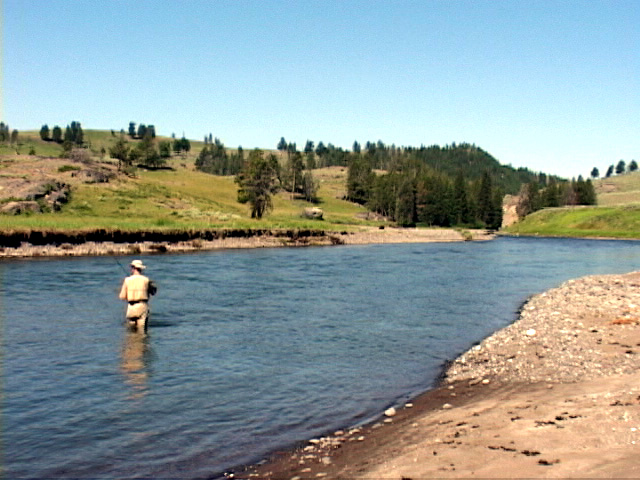
      The Lamar River is my favorite stream in the Yellowstone National Park. It is in the upper eastern section of the park and one of the last streams in the park to get into a good condition to fish. Most of the trout are cutthroats but the other species of trout are also there. It is 44 miles long and the largest tributary to the Yellowstone River.
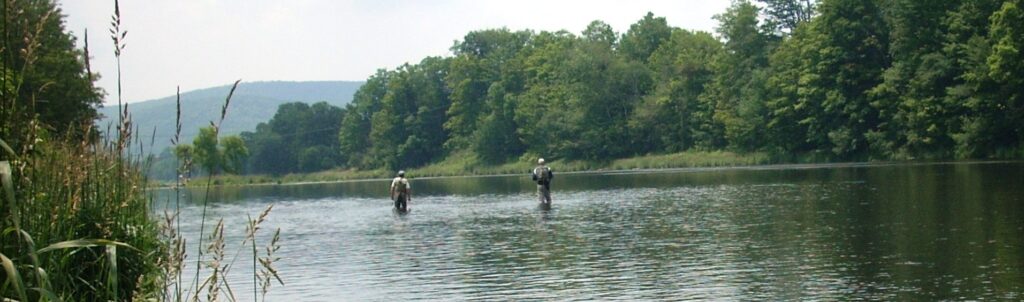
      Fly Fishing Tailwater Streams

      Two anglers fishing the West Branch of the Delaware in New York a few miles below Cannonville Dam

      The West Branch is an excellent tailwater. Just in case you are very new to fly fishing, please be advised that tailwaters are streams that lie below man made dams. Many tailwater streams didn’t have any trout prior to construction of the dam but others did. Generally, if the stream was in a climate where the water temperature didn’t exceed the high sixties to the low seventies during the hottest summer months, there was usually a population of trout. Streams that had water that exceeded the high sixties to low seventies during the hottest summer months did not have a population of trout. In many, if not most of those cases, constructing a bottom release dam of substantial height, released water cold enough to support trout at least for all except the warmest months of the year. Many such dams released water cold enough to support trout year round. The ability of the tailwater stream to support trout greatly depends on how cold the water being released is, how often it is released and the volume of water that is being released. Almost all tailwater streams vary greatly in respect to how much, how often and how cold the being released is. Construction of the dams for flood control and electrical energy throughout the nation has resulted in tailwater streams that vary greatly in this respect. Some are capable of supporting trout year round and others for only the colder months of the year.

      New Euro Nymph Flies

      https://perfectflystore.com/product-category/flies/standard-generic-low-price-trout-flies/euro-nymphs-trout-flies/

      New Perfect Fly Euro Nymph/Hi-sticking Fly Rod Series

      https://perfectflystore.com/wp-admin/post.php?post=38881&action=edit

    7. Great Smoky Mountains National Park Trout In Low Water Conditions

      A fishing report I received from Derek Porter:

      We just got back from 4 days in the smokies backcountry.  As you know, the water is the lowest it’s been since 2016. Obviously had to use great caution approaching the creek and casting, moving around etc.  We saw tons of Great Autumn Brown Sedge in the air – laying eggs all day long (usually you think of it as a dusk or dawn thing). Maybe because so much of the creek is in the shade all day?  Also – tons of cream midges and BWO.

      In my experience the Sedge are smaller than the size 10 you sell. I’d say they are 12 or even 14.  This continues to be the case every year for me.

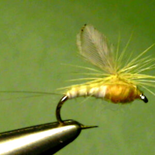
      Caught a lot on cream midge pupa and blue-winged dun emerger.  Even though water temps started in the 40s every day we had dry fly action all day long.  Dry/dropper was the best way for us to present the nymphs. The low current made it hard to keep drifts going on the nymphs and the dries were getting hit all day so it was a win/win.

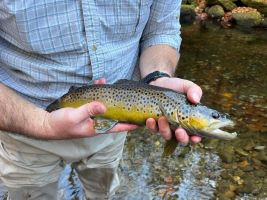
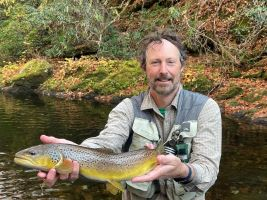
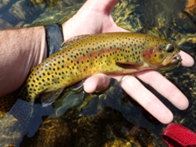
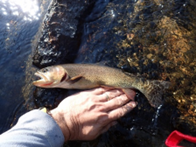
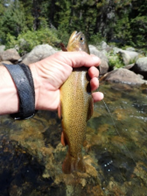
      Here are a few photos.  Actually caught the big male on the Perfect Fly Articulated Black Bull Head Sculpin.  All the fish we caught were in great shape. We didn’t see any redds or spawning activity and the females fins looked good. I imagine things will be kicking into high gear soon. Glad we were there before the spawn.  Hope the forecast for rain really arrives.

      Derek

    8. Wind River Magic

      Backcountry Fly Fishing on the Rooftop of Wyoming

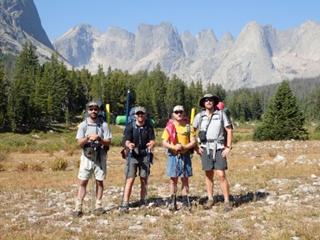
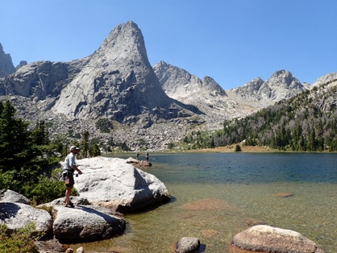
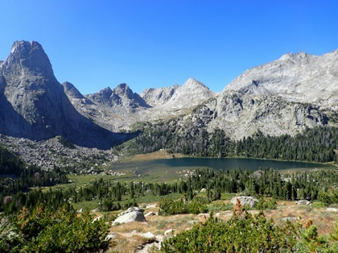
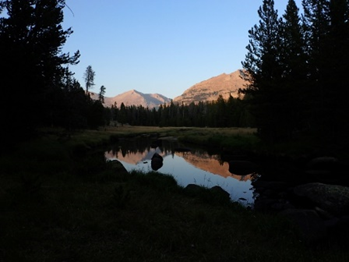
      If you are looking for a remote western backcountry experience where the variety of the terrain and scenery is equally matched by the variety of fish you will catch then look no further than the Wind River Range of the Rocky Mountains in Wyoming. The WRR encompasses 2.25 million acres in an area roughly 110 miles long and 35-40 miles wide. The crest of the range forms the Continental Divide and three major western rivers are born on the 175+ glaciers still clinging to the peaks: the Gros Ventre River, which flows into the Snake River; the Green River, which is the largest fork of the Colorado; and the Wind River, which becomes the Bighorn and is the largest fork of the Yellowstone River.  This is the land where the Shoshone Indians once lived and portions of the range are inside the Wind River Indian Reservation. The paths they pioneered back and forth over the mountains are incorporated into the over 700 miles of trails that can be utilized to access some of the most remote and beautiful areas in the lower 48.Historically most of the alpine lakes in this region were devoid of trout. Isolated in hanging valleys their outlet streams contained steep waterfalls that proved to be a barrier to upstream migration.  The native cutthroats had managed to establish populations in only a handful of the lakes at the edge of the mountains. In 1929 Finis Mitchell established a fishing camp in the Big Sandy Openings and for the next seven years through the Great Depression he stocked hundreds of remote lakes with an estimated 2.5 million trout by horse packing in five gallon buckets full of fingerlings.  Today we benefit from these efforts and others that followed including federal and state stockings programs.  We are blessed with a wilderness area that is four times larger than the Smoky Mountains and contains over 1,000 lakes with miles of creeks connecting them. With cutthroat, rainbow, brook, golden, brown and lake trout to be found throughout the range the hardest decision might just be, “Where do I start?”In August my buddies and I completed a six day backpacking and fishing trip through the Winds.  Our forty mile loop led us over a route with elevations ranging between 9,000 and 12,000 feet.  We went through forests of lodgepole and whitebark pines, climbed into alpine meadows, and traversed through barren passes and plateaus where it was hard to even spot a tree below us.  We crossed the Continental Divide in two separate places and walked past more than twenty lakes ranging from the size of a football field to over two miles long.  Perhaps our greatest challenge was having to decide where not to fish because we simply did not have time to fish them all.Our trip started and ended at the trailhead at the Big Sandy Lodge.  This is the site where Finis Mitchell had established his tent camp eighty-five years ago. We headed north along the Continental Divide Trail gradually gaining elevation to the open meadows of Fish Creek Park.  We passed several lakes and creeks until arriving at Skull Lake to set up camp.  Here we were surprised to find a group of rangers with the Wyoming Game and Fish Department.  We were over 10 miles from the trailhead and these guys had carried in a raft and a system of nets to assist in fish population studies. It was great to see these men working to further improve the fishing in such a remote wilderness.  Hungry brook trout sipped BWO duns and emergers nearly every cast we made into the lake as the evening sun set the crest of the Rockies on fire in the background.
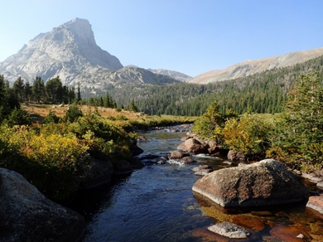
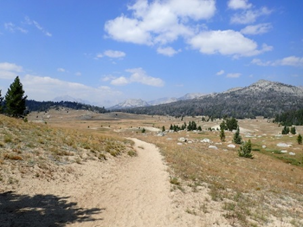
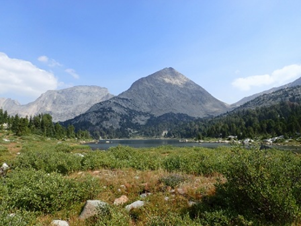
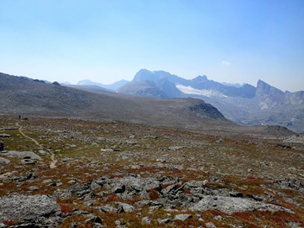
       Views of distant mountains emerged as we arrived at Fish Creek Park

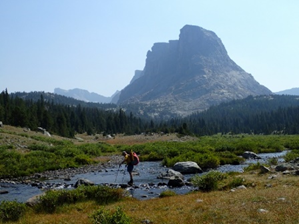
      Mae’s Lake is guarded by the distinctive Pyramid Peak

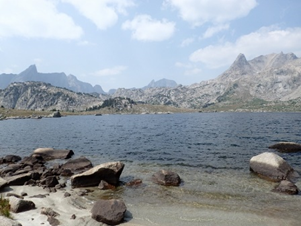
       Alpine terrain surrounds Pyramid Lake

      The next morning we continued on past Mae’s Lake to the desolate Pyramid Lake.  This stunning fifty-five acre lake sits about a half-mile from the Continental Divide at 10,570 feet and is completely above tree line.  At this point we had left the trail but a one mile cross country scramble brought us to the Continental Divide at 11,600 feet where we dropped down to reconnect with the trail at Hailey Pass. We had now left the waters that ultimately drained into the Colorado River and entered the Wind River drainage.  It was hard to imagine that the snowfield just below our feet was destined to flow all the way to New Orleans via the Wind, Bighorn, Yellowstone, Missouri, and finally Mississippi River!

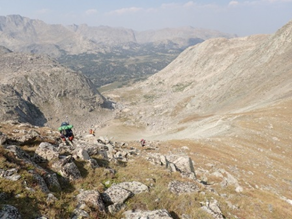
       Descending from the Continental Divide towards Hailey Pass

      We descended over 1,600 feet in the next 1.5 miles to reach the shore of Grave Lake.  This two hundred acre lake with a shoreline over two miles long would be the largest we would pass and the wind took advantage of this open space; as the waves crashing into the shore and spraying foam gave one the feeling of being at the beach instead of in the mountains.  We caught cutthroat here and lake trout reportedly patrol the deeper depths that exist out beyond the shelf that extends in some places over 100 feet from the shoreline.The following morning we dropped our packs at the outlet and fished the stream and the lake.  Once again the wind was in our face but we were rewarded with nice trout that would rise to dry flies as well as ambush deep damselyfly nymphs that were dredged through the channel creating the outlet.

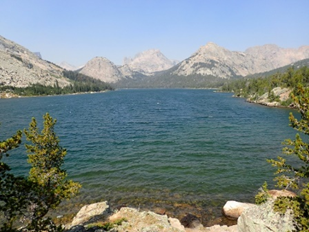
       A view back up Grave Lake from near the outlet

      From the outlet we descended through the forest and within two miles arrived at the South Fork Little Wind River. This beautiful stream ranged from 10-20 feet wide and was full of trout.  We    dropped our packs and set up our rods, eager to fish moving water for a change. Speckled Wing Quills were in the air and the four of us spread out across a half mile stretch of the creek. Nobody was disappointed.  Almost every cast was met with a strike from a brookie, cutthroat, or cutbow hybrid.

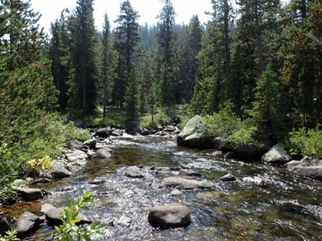
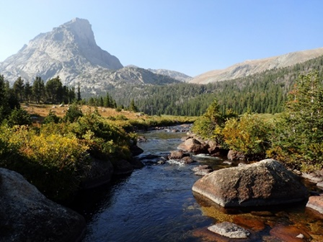
       A typical stretch of water in the magical South Fork Little Wind River We shouldered our packs and hiked upstream into the headwaters, a tremendous basin called Ranger Park which contains over a dozen lakes holding trout.  We climbed up to a shelf and found Valentine Lake tuck up against the steep walls of Windy Mountain.  After setting up camp we fished the lake, catching numerous brook trout on dry flies as well as damselfly and streamer patterns.  Fishing the lakes can be hit or miss.  Sometimes the trout seem to be out and feeding and other times you can walk around the entire shore and never see a trout.  Fortunately, this evening the trout were cooperating and we fished till dusk.

       Crossing the creek in Ranger Park with Buffalo Head looming in the backgroundThe next day our destination was the headwaters of the North Fork Popo Agie River, another tributary to the Little Wind River.  Our travels took us up and across the barren windswept slopes of Windy Mountain.  The trail runs for over five miles above tree line at elevations exceeding 11,000 feet.  A brief scramble to the top of nearby Cathedral Peak gave us an unrestricted 365 degree view from the 12,326 foot summit.  The broad ridgetop of Windy Mountain is not a place you would want to be during fog or storms and we were fortunate to have crystal clear skies (and wind, of course).  We arrived at Lizard Head Meadows and set up our camp at a point where the valley began to lose elevation as it dropped to the east.  This gave us an opportunity to fish both a section with swift runs, plunge pools and pocket water as well as an upper section where the creek more closely resembled a swimming pool – crystal clear and just a few feet deep with hardly any measureable current.  This turned out to be an excellent place to practice casting as a poor presentation or shadows from your line would set off a chain reaction of spooked fish. 

       The barren slopes of Windy Mountain. Not a tree to be found.Our campsite was located about two miles below the headwaters of the creek, which is formed in a stunning granite basin called the Cirque of the Towers.  The cirque is an international rock climbing destination, with hundreds of technical climbing routes available.  If there is a more beautiful place to catch trout then I have not found it.  We were rewarded with incredible views as the sun set and dusk came upon us.

       North Fork Popo Agie with Lizard Head in the background.

      From left to right: Joe DeLisle, Neff Jenkins, David Ewing, and Derek Porter.

        Sunset in the Cirque of the Towers

      The following morning we broke camp and walked upstream in the cirque to the aptly named Lonesome Lake.  The lake sits at 10,166 feet and is surrounded by a horseshoe shaped string of peaks towering over 2,000 feet above. After four days of wind we were finally rewarded with calm conditions.  The location of the lake deep in the bottom of an ancient glacial valley sheltered us from the winds blowing high above.  The calm conditions allowed us to see the trout cruising around the gin clear waters of lake.  They were sipping emergers just below the surface.   We spread out along the shoreline to find positions where we could make the long backcasts.  There were boulders that could be waded out to as well as a shelf that could be waded out on so that you could reach the deeper water beyond.  At first my offerings were met with mixed results but things improved immensely after switching to a 12 foot leader with size 20 midge adults with a pupa dropper. The longer leader with small flies definitely increased the chances of fooling the trout.  For a few hours we all caught cutthroat after cutthroat.  Never before have I fished a spot where every single trout was spotted before being cast to.  Many of the trout were over 70 feet offshore which was feasible to reach when the wind was light and if you could find a spot for your back cast.  The larger trout when hooked would take wide, sweeping runs as they desperately attempted to return to the depths of the lake.  The combination of the scenery and the water conditions was surreal.  We had plans to move on and fish other waters that day, being skeptical of how many trout we could catch in a lake at an elevation over 10,000 feet.  On this afternoon however those plans were scrapped without even a discussion.  There was no way were leaving this spot to fish anywhere else on this day.  The fact that our car was over ten miles away and on the other side of the Continental Divide is the only reason we grudgingly broke down our rods, packed up and left.  It turned out to be the perfect spot to make our final casts of the trip. 

       Sight fishing on Lonesome Lake

       A view of the cirque and Lonesome Lake as we climb towards Jackass Pass

      We crossed back over the Continental Divide at the curiously named Jackass Pass and began our descent towards Big Sandy Lake. Soon thereafter we were walking downstream along the Big Sandy River, reflecting on the trip as the sun set over the mountains to our left.  A few miles later we set up our last camp in the dark, satisfied that we had made the most of our time in Wyoming’s Wind River Range Range. 

      Reflections on the Big Sandy River near dusk  Fish caught along the way:  (next page)

    9. Matching the Hatch

      Introduction

      The Word Hatch

           The is the first article of a new series of posts on “matching the hatch”. The phrase “matching the hatch” is often used by fly anglers fishing for trout and sometimes for other species such as bass, pike, etc. During the last several years the phrase has even been used by anglers using conventional tackle fishing for many different species of fish. In those cases, the word hatch doesn’t necessarily mean the same as it does when it is used by fly angler.

           When fly anglers are fishing for trout and other species of fish that feed on insects, the word “hatch” refers to the point an insect begins to crawl or accent to the surface of the water to change into its adult stage of life. Keep in mind, that is usually a short time ranging from a few hours to a few days depending on the species of the insect.

      KISS – Keep It Simple Stupid

           I will do my best to keep the articles on “matching the hatch”, as simple and understandable as possible. All aquatic entomology books use more technical explanations of hatching insects. To begin, they are classified as complete metamorphosis, which has four stages – egg, larva, pupa, and adult. Insects that go through three stages of change in their life cycle have an incomplete metamorphosis.

      For example, mayflies undergo complete metamorphosis. Caddisflies undergo incomplete metamorphosis. Stoneflies undergo incomplete metamorphosis and midges undergo complete metamorphosis.

           Mayflies go from an egg to a nymph, to a dun and to a spinner.  Caddisflies go from an egg to a larva, to a pupa, to an adult. Stoneflies go from an egg to a nymph and to an adult. Midges go from an egg to a larva, to a pupa, and to an adult.

      The Book “Matching the Hatch

      The Word Matching

      The book, “A Practical Guide to Imitation of Insects Found on Eastern and Western Waters” written by Ernest G. Schwiebert, pointed out the importance of using flies that match whatever insects are hatching at any time and place. The only problem I have with it is that it focused only on matching adult insects such as mayfly duns, stonefly, and caddisfly adults. It didn’t focus on the importance of matching the nymph or larva stages of life of the insect. Neither did it focus on the importance of matching the imago stage of life, which in the case of mayflies is the final stage of life that anglers call spinners. Most of the emphasis was focused on matching the subimago stage of life which in the case of mayflies is what anglers call the dun.   

           The word “matching” as used in the phrase “matching the hatch”, is intended to mean anglers should use flies that closely resemble the insects that are hatching at any time and place. One major problem with the book is the lack of pictures showing artificial flies that look like the real things. Out of the hundreds if not thousands of flies on the market at the time, few matched the real insects well. In fact, almost none of them matched the nymphs or larva stages of the insect’s life. In fact, except for Perfect Flies, that is still the case. Perfect Fly’s approach to matching the hatch includes matching the larva or nymphal stage of life as well as the adult insect.

      To be continued in the next article.

      Matching the Hatch is what Perfect Fly is all about. You can match what is going to hatch (nymphs and larvae, what is hatching (emerging and adult stages of life) and what has hatched and returned to the water to deposit eggs for future generations – the egg laying activity. In the case of mayflies, it would consist of matching the spinners. be continued in the next article.

      The top picture is a Perfect Fly Light Cahill Dun. The lower picture is a real Light Cahill.